 Brief Shapes
The Sphinx knows how to begin an encounter: with danger, authority and a question that has exactly one right answer. She is less prepared for what happens after somebody gives it. Our musical imagines a meeting in which the terrible quiz slowly reveals a much less terrible wish. She would like the traveller to stay, but first she has to let him leave.
The answer that opens Thebes
In Pseudo-Apollodorus’s Library 3.5.8, Hera sends the Sphinx to afflict Thebes. She combines a woman’s face with a lion’s body and a bird’s wings. She asks about the creature that has one voice but goes on four feet, then two, then three. Failed answers cost lives. Oedipus recognizes the human life cycle: crawling infancy, upright adulthood and old age supported by a staff.
After the solution, the Sphinx throws herself from the citadel. Oedipus receives the kingdom and marries Jocasta, not knowing the relationship that will make his success catastrophic. The musical does not reproduce that conclusion. Its traveller is unnamed, its questions continue, and its ending is an openly invented alternative encounter.
Sources: Pseudo-Apollodorus.
More than one kind of threat
Pausanias records competing explanations at Description of Greece 9.26.2–4. Alongside the riddle-telling creature, he reports a Sphinx who leads a raiding force and is overcome by Oedipus’s army. Another account makes her a daughter of Laius who tests rival claimants with a secret oracle. These are alternatives reported by an ancient writer, not historical facts established by modern research.
None supplies our lonely conversationalist. Their interest here is that antiquity itself could explain the figure differently. We keep those explanations separate rather than stitching the pirate, royal daughter and winged monster into one biography. Our chosen starting image is the dangerous guardian of the Theban road.
Sources: Pausanias.
One more, and one more
The first question sounds monumental. The traveller’s answer is gentle, familiar and almost inconveniently easy. The Sphinx cannot sustain her authority by pretending it is wrong, so she expands the examination. The repeated promise of one more riddle becomes the musical engine: each apparent ending is followed by a fresh reason not to end.
The questions move from recognizable puzzles toward preferences: a place to sit, a favourite time of day, a possible return visit. Their change matters more than their difficulty. What began as a test of the traveller’s knowledge becomes a hesitant attempt to discover whether there might be room for her in somebody else’s afternoon.
We do not ask him to prove his kindness by surrendering his freedom. The emotional turn belongs to her decision to clear the road without attaching a final condition. Only after that can his decision to sit down mean something different from captivity. The bread he offers is ordinary hospitality, not a prize extracted through a threat.
The final exchange gives the Sphinx a question about a name. The creature famous for demanding answers has not yet asked who her companion is. That reversal lets the song change its rules without abandoning its refrain. Another question no longer means another obstacle. It can mean attention freely given.
Keep the grandeur; change the pause
The production artwork uses a monumental winged figure against a rocky landscape, with gold and blue-green ornament that gives the scene a storybook, Art Nouveau character. This is the Greek Theban encounter, not a claim that every ancient sphinx belonged to this story. The scale remains impressive even as the emotional balance changes.
We wanted the beginning to retain enough danger that the warmth would be a development, not a disguise revealed immediately. Humour emerges from her seriousness and from the widening gap between the official purpose of the questions and the personal thing she is trying to ask. Companionship, rather than an announced romance, is enough for the ending.
The road stays open. That is the condition that makes another shared moment possible. In a collection concerned with brief things, an afternoon voluntarily extended can be a more satisfying victory than a monster defeated.
One More Riddle
One brief shape.
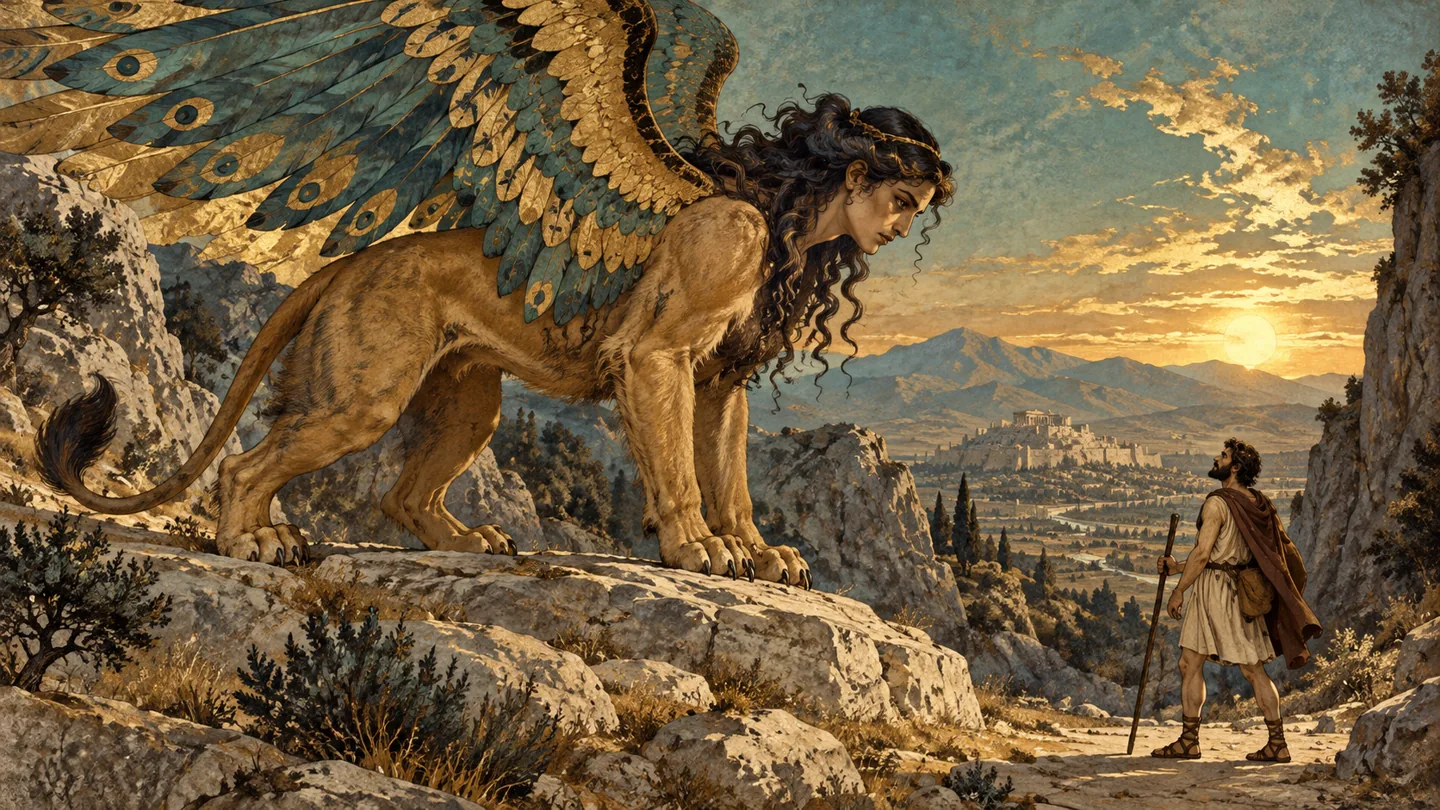
Brief Shapes film artwork: an artistic interpretation, not an archaeological reconstruction.
Sources & further reading
Ancient accounts and the original situation created for this musical are distinguished below. This introduction follows selected surviving sources; it is not an exhaustive catalogue of every tradition.
- Pseudo-Apollodorus · Library3.5.8 · translated by J. G. Frazer. Read the source ›
The Theban Sphinx, the human-life riddle, Oedipus and her death. - Pausanias · Description of Greece9.26.2–4 · translated by W. H. S. Jones. Read the source ›
Alternative accounts of the Sphinx as raider or daughter of Laius.
Beyond our artwork
The Met’s marble sphinx on a cavetto capital, ca. 580–575 BCE (24.97.87), once crowned an Attic grave monument. It illustrates a different ancient use of the sphinx image, not the film’s invented conversation.
A sphinx above an ancient grave ›
External museum record; its image remains on the institution’s website. No reproduction rights are implied.