 Brief Shapes
One man, one enormous stone and another excellent idea. Our Sisyphus meets an impossible task with engineering, negotiation and a confidence that survives repeated evidence against it. The comedy is exuberant, but the film does not require us to believe that he will finally defeat eternity. Its quieter question is what can be lived inside an endeavour that will not end.
The moment before the summit
In Odyssey XI.593–600, Odysseus sees Sisyphus among the dead, forcing a huge stone uphill with hands and feet. Just as he is about to push it over the crest, it turns and rolls back down. He begins again, sweating in the dust. The passage gives the punishment in a concentrated image; it does not explain its cause there or supply a sequence of escape plans.
The almost-achieved summit is essential to our film. The task repeatedly offers the shape of success without permitting its completion. We retain that mechanism instead of giving the story a final victory that would remove the very condition it is exploring.
Sources: Homer.
A secret told against Zeus
The Library I.9.3 identifies Sisyphus as a son of Aeolus, founder of Ephyra, later Corinth, and husband of Merope. It connects his punishment with his disclosure to Asopus that Zeus had carried away Asopus’s daughter Aegina. Here the stone has a stated cause: Sisyphus has exposed a divine secret.
This is one explanation, not an instruction to add every story about Sisyphus’s cleverness to a single seamless biography. Our musical does not stage the betrayal or pronounce a verdict on whether the punishment is deserved. Its starting point is the hill after the sentence has become his daily reality.
Sources: Pseudo-Apollodorus.
The principle was surely right
The original lyric gives him three strategies. First comes a lever: a branch, a brick and a confident explanation of mechanics. Then comes a pulley arrangement that appears promising until the apparatus follows the stone. Finally he approaches the rock as a negotiating partner, complete with chairs, tea and a contract. Each change of method lets optimism find a fresh vocabulary.
The contraptions and bargaining are inventions for this film. They do not illustrate a sequence found in Homer or the Library. The joke depends on Sisyphus treating a metaphysical punishment as though it might yield to better equipment, better wording or a sufficiently professional meeting.
The published film description also makes our deeper intention explicit: Sisyphus knows that the stone will fall and still brings enthusiasm and effort to the climb. We are interested in embracing an impossible endeavour without needing a promise of victory. His energy need not be explained only as ignorance of what is happening.
The flower beside the track changes the scale. He has almost crushed it; now he moves his boot, sits nearby and gives it shade. Nothing about the hill has been solved. What changes is the range of things he can notice. For a moment, the task no longer occupies the entire world.
The final chorus revises the terms of triumph. The flag can stay beside the path, and the flower can receive the useful shade. The repeated work continues, but a brief act of care has entered it. That is not a reward bestowed by the gods for good behaviour. It is something he does within the conditions he already has.
The last tumble preserves both the punishment and the joke. We resist converting the flower into a magical key or a sentimental explanation that makes suffering necessary. The small encounter matters without redeeming every part of his situation. His renewed certainty remains funny, and his willingness to begin again remains moving.
An enormous rock, a small change of view
Graphic-novel animatics and selective animation give the musical a scale large enough for its absurd engineering. The chosen artwork shows a grinning, weathered man braced against a boulder beneath a turbulent sky. Its monumental landscape gives the task weight; his expression refuses to let weight become the only fact in the image.
The rock-and-roll setting supplies momentum while the failures interrupt it. Against that forward drive, the flower scene can become a pause rather than another device in the plan. Our visual world is invented mythic theatre, not a reconstruction of an ancient Underworld map.
Brief Shapes is drawn to temporary things. In a story built around endless repetition, that means noticing the interval: a rest, a little shade, a living thing at the edge of an impossible job. The stone will move again. The interval still happened.
This Time for Sure
One brief shape.
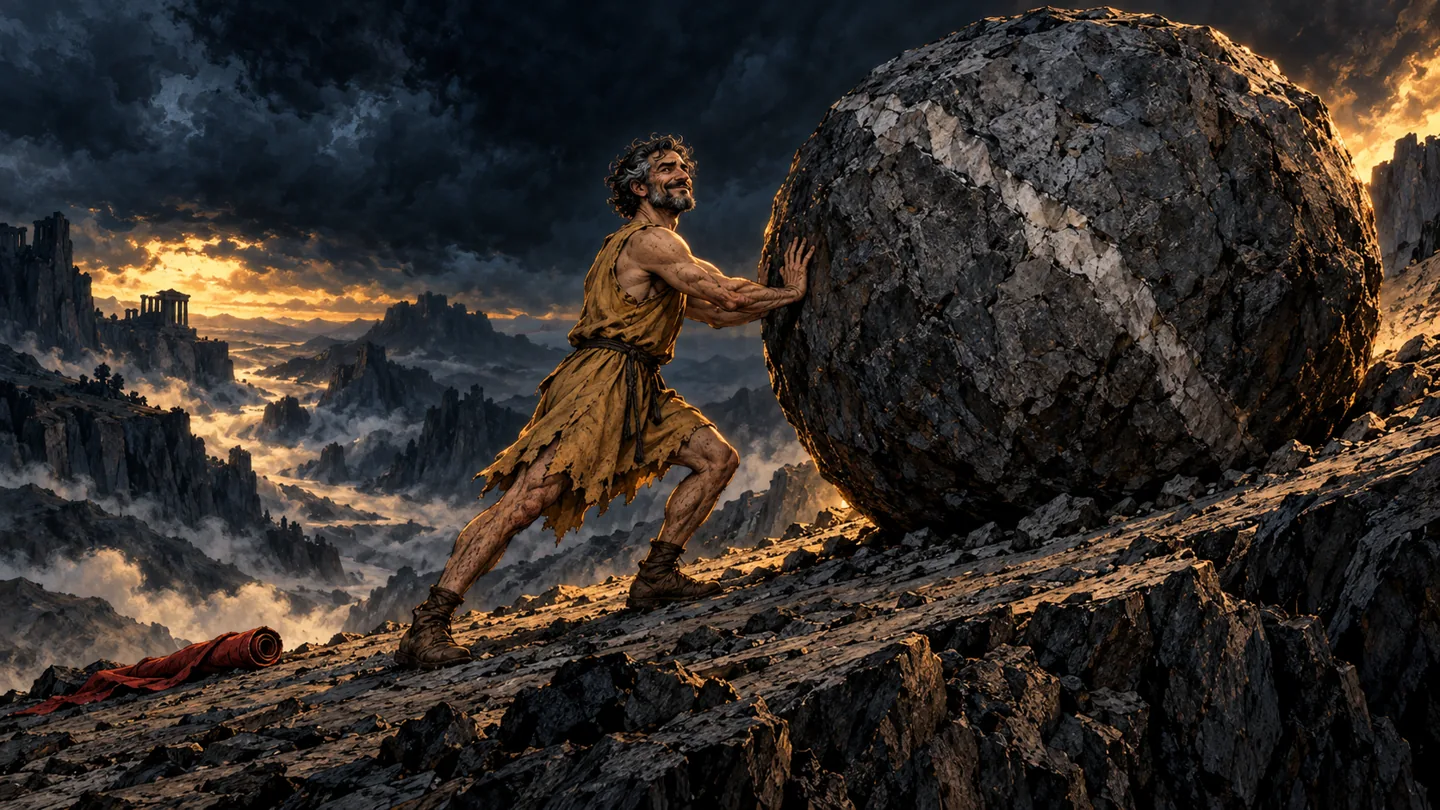
Brief Shapes film artwork: an artistic interpretation, not an archaeological reconstruction.
Sources & further reading
The ancient sources and our modern musical interpretation are distinguished below. This is an introduction to the cited traditions, not an exhaustive catalogue of every ancient reference.
- Homer · OdysseyXI.593–600 · translated by A. T. Murray. Read the source ›
The stone’s repeated ascent and fall in the Underworld. - Pseudo-Apollodorus · LibraryI.9.3 · translated by J. G. Frazer. Read the source ›
Sisyphus’s genealogy, Corinth and disclosure of Zeus’s seizure of Aegina.
Beyond our artwork
Titian’s painting, made in 1548–1549 and held by the Museo del Prado, is Renaissance reception of the myth, not an ancient image. Its monumental punishment makes an illuminating contrast with our comic, attentive climber. The image stays on the external institution’s site; no reproduction rights are implied.
External museum record; its image remains on the institution’s website. No reproduction rights are implied.