 Brief Shapes
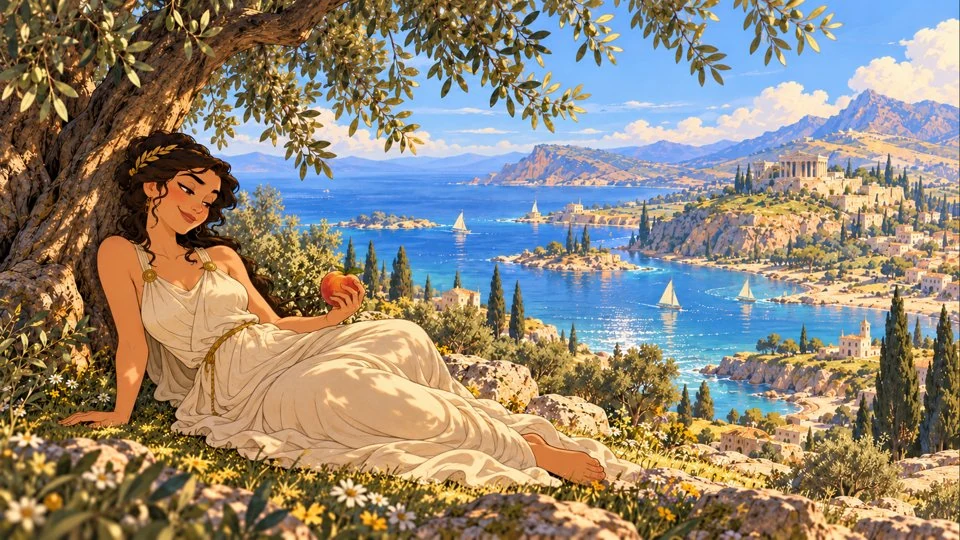
This is not a story about becoming powerful enough to defeat a god. In our film, Sinope listens, lets the promises grow, and chooses her moment. The comedy belongs to the men who mistake their magnificence for an answer to a question she has not asked. Her victory is smaller than a kingdom and, to her, considerably more valuable: she gets to decide what happens next.
A promise can leave a god with nowhere to go.
The promise that left her free
In Book II of Apollonius Rhodius’s Argonautica, the Argonauts reach the shore where Zeus has given Sinope a home. She is a daughter of Asopus. Zeus desires her and promises to grant whatever she wishes. Sinope asks to remain a virgin. His own offer defeats his intention. The poet says that she similarly outwits Apollo, who wants to marry her, and the river Halys; neither divine nor human lovers possess her.
The episode is brief. It supplies the promise, the clever request and the three unsuccessful suitors, but not an extended conversation or a theatrical competition between them. Our film takes that compact incident as its starting point, rather than pretending that its dialogue and spectacle were preserved in the ancient poem.
Read the ancient account: Apollonius Rhodius.
A name attached to a city
Diodorus Siculus tells a different story in Library of History IV.72. He names Sinope among the daughters of Asopus and Metope. Apollo carries her away to the place where the city of Sinope stands, and the city takes her name. In this account she and Apollo have a son, Syrus, whom Diodorus connects with the naming of the Syrians.
This is a competing tradition, not a later chapter of Apollonius’s account. We present it separately because combining the two would erase their disagreement. The film follows the tradition of Sinope’s successful refusal; it does not adapt Diodorus’s story of abduction and descent.
Read the ancient account: Diodorus Siculus.
Three magnificent distractions
We turn the suitors into a splendidly competitive trio. Zeus, Apollo and Halys want Sinope’s attention, but they also want to outshine one another. Every display becomes an argument about which god deserves to win. Their courtship starts to resemble a performance for each other, with Sinope expected to provide the applause.
She refuses that role without losing her sense of humour. Her glances, small smiles and moments of disbelief give the spectacle its scale. The gods can fill the scene; they cannot make her desire what they are offering. We wanted her to enjoy their absurdity, not merely endure a procession of threats.
That amused confidence is our artistic choice. So are the musical exchanges, the shared afternoon, the elaborate divine displays and the peach. These details give the ancient manoeuvre a texture of everyday pleasure. Against all that grandeur sits something wonderfully ordinary: a woman who would rather enjoy her own time.
The ancient request concerns virginity. Our emphasis is on the freedom to choose, not on sexual purity as a superior way of living. Sinope does not need a hidden lover, a tragic explanation or a future reward to justify her answer. Her wish matters because it is hers. Nor do we ask the viewer to conclude that love itself is a trap. The mistake belongs to those who treat another person’s consent as the inevitable outcome of a sufficiently impressive offer.
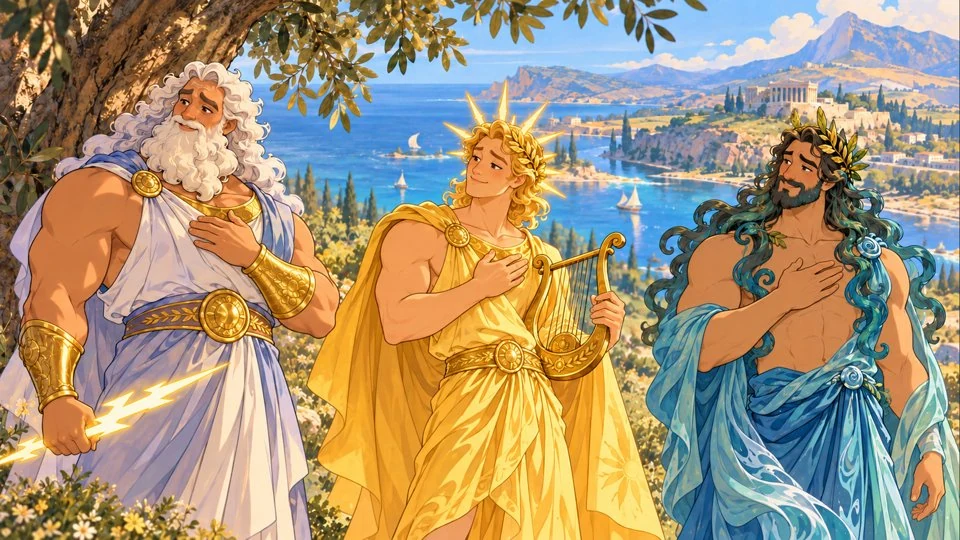
The expression between the spectacles
The gallery on this page belongs to our interpretation, not to the archaeological record. Its images are another way of telling the story, not evidence for how ancient audiences imagined Sinope. We invite you to look at her reactions as closely as the gods’ entrances: the comedy often happens in the pause after a grand gesture. A small expression can answer an enormous claim. The setting and costumes establish a world of myth, but the familiar exchange beneath them is the reason to linger: someone is trying very hard to impress, and someone else is quietly making up her own mind.
A little time, entirely her own
Brief Shapes often looks at fleeting human moments through the lives of immortals. Here the everlasting figures compete for importance while Sinope keeps something temporary: an afternoon. It can be tasted, enjoyed and allowed to pass. Its brevity does not make it worthless.
That is the note we wanted to leave after the music. Not a throne seized or a rival destroyed, but a person still in possession of herself. The gods have made their entrance. She can let them make their exit. There is still a little daylight left.
The Afternoon Is Mine
A few brief shapes.
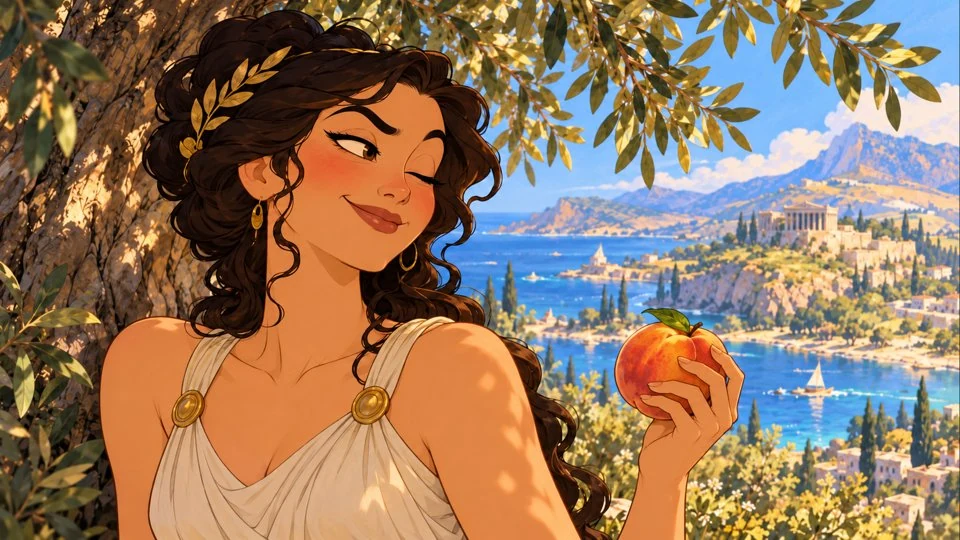
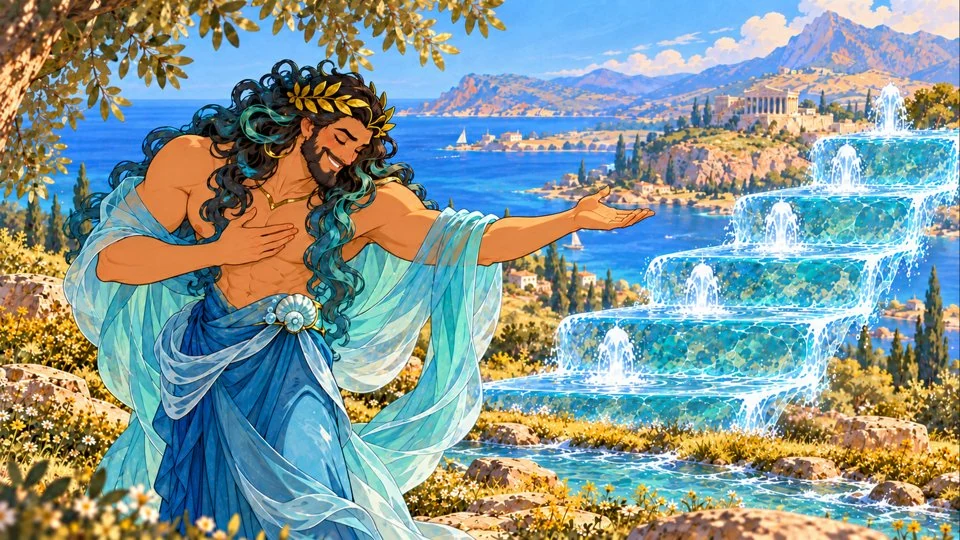
All gallery images are Brief Shapes film artwork. They depict our interpretation, not ancient objects.
Sources & further reading
This page distinguishes two ancient accounts from the original dialogue, staging, music and visual interpretation created for the Brief Shapes film. It is an introduction to the cited traditions, not an exhaustive catalogue of every surviving reference.
- Apollonius Rhodius · ArgonauticaBook II, lines 946–954 · translated by R. C. Seaton. Read the source ›
The promise and the successful refusal of Zeus, Apollo and Halys. The relevant paragraph begins at [946] in this translation. - Diodorus Siculus · Library of HistoryBook IV, 72.1–2 · translated by C. H. Oldfather. Read the source ›
The different account of Apollo, the city’s name and Syrus. Look for The Daughters of Asopus, [4.72.1]–[4.72.2]. - Theoi Project · SinopeSource excerpts and reference overview. Read the source ›
A useful gateway to additional attestations. Its editorial overview and quoted translations are distinct from the two primary-text translations cited above.
See an ancient image
The British Museum holds a silver drachm minted at Sinope, dated approximately 410–350 BCE. Its catalogue identifies a head of the nymph Sinope; the reverse shows an eagle holding a dolphin. This is ancient civic imagery, not an illustration of the promise episode or a historical portrait.
View the coin and its museum record ›
British Museum, museum number 1919,0515.14. The image remains on the museum’s site; no reproduction rights are implied.