 Brief Shapes
Pandora often arrives in retellings already carrying the blame. Our film begins by noticing that she has been made to serve somebody else’s purpose. The gods arrange a gift; inside that arrangement stands a person. This Little Song Is Mine keeps the suffering released into the world, but turns toward what Pandora might choose after a choice has gone terribly wrong.
A gift designed as retaliation
In Hesiod’s Works and Days 42–105, Zeus responds to Prometheus’s theft of fire by ordering the creation of a woman. Hephaestus fashions her, other gods supply attributes and adornment, and Hermes brings her to Epimetheus. He accepts despite Prometheus’s warning against gifts from Zeus. Pandora removes the lid of a jar; suffering spreads among mortals, while Hope remains inside when the lid closes.
The vessel in this account is a jar, not the familiar small box of later retellings. Hesiod does not give Pandora our motive of hearing a trapped presence and wanting to help. The film’s compassionate impulse is an invention. The text’s ending also deserves care: Hope remains inside. It does not narrate a cheerful second opening in which Hope flies out and repairs everything.
Sources: Hesiod.
The woman, without the jar episode
The Theogony 570–612 tells a related but differently framed account. A beautiful woman is fashioned and adorned as the cost of the stolen fire, and the poem proceeds into a hostile generalization about women and marriage. This passage does not supply the jar episode told in Works and Days. The two texts should not be treated as identical descriptions with interchangeable details.
We identify that ancient hostility rather than quietly adopting it. Our film does not argue that women are a divine mistake, or that one woman should bear moral responsibility for all human pain. Giving Pandora a perspective of her own is a creative response to the inherited framing, not a claim that Hesiod wrote a sympathetic first-person song for her.
Sources: Hesiod.
Listening before opening
In our telling, Pandora opens because she believes something inside needs help. That change makes the action an error of compassion rather than a convenient illustration of female curiosity. It does not erase its consequences. Wanting to do good is not the same as understanding what will happen, and the film allows that painful distinction to remain.
The movement from the gods’ carefully arranged gift to a woman sitting beside the jar changes the scale of the story. At first she belongs to a design made by others. At the end she can make a small decision of her own. The song is hers in a way that the divine assignment never was.
We deliberately keep the jar closed at the end. No little creature of Hope emerges as a visual promise that everything will now be fine. The world has not been magically repaired. Pandora’s song is not a mechanism that reverses the release or turns loss into a lesson with an easy reward.
That restraint matters to the tenderness. Sitting beside something is a modest action; it can be an expression of care without being a solution. The film’s hope lives in that continued attention. Pandora does not need to become all-powerful in order to stop being merely the instrument of a powerful god.
This is our emotional interpretation, not a definitive answer to every question raised by Hesiod’s Hope. The ancient image of something remaining within the vessel is spare and unsettling. We leave room for that uncertainty rather than announcing that the source has one obvious modern moral. Our version asks what a person might do in the presence of consequences she cannot undo.
Colour that refuses to harden
The film uses an impressionist watercolor language: blue and amber washes, broken colour and surroundings that are suggested rather than exhaustively described. The selected image places Pandora beside a large decorated jar, leaning close under moonlight. The vessel is tangible and prominent; the scene does not replace it with a generic magical box.
The still-image format lets the eye move through light, cloth and small gestures without turning every feeling into an animated performance. Restrained camera movement supports the music. These painted spaces are artistic inventions, not evidence for ancient clothing, interiors or pottery decoration.
For Brief Shapes, the ending belongs to the small things that continue after grandeur fails: someone remains, listens and sings. The title is not a claim to possess the world or correct its history. It is a claim to one brief act within it. That is deliberately smaller than the gods’ design, and more personal.
This Little Song Is Mine
One brief shape.
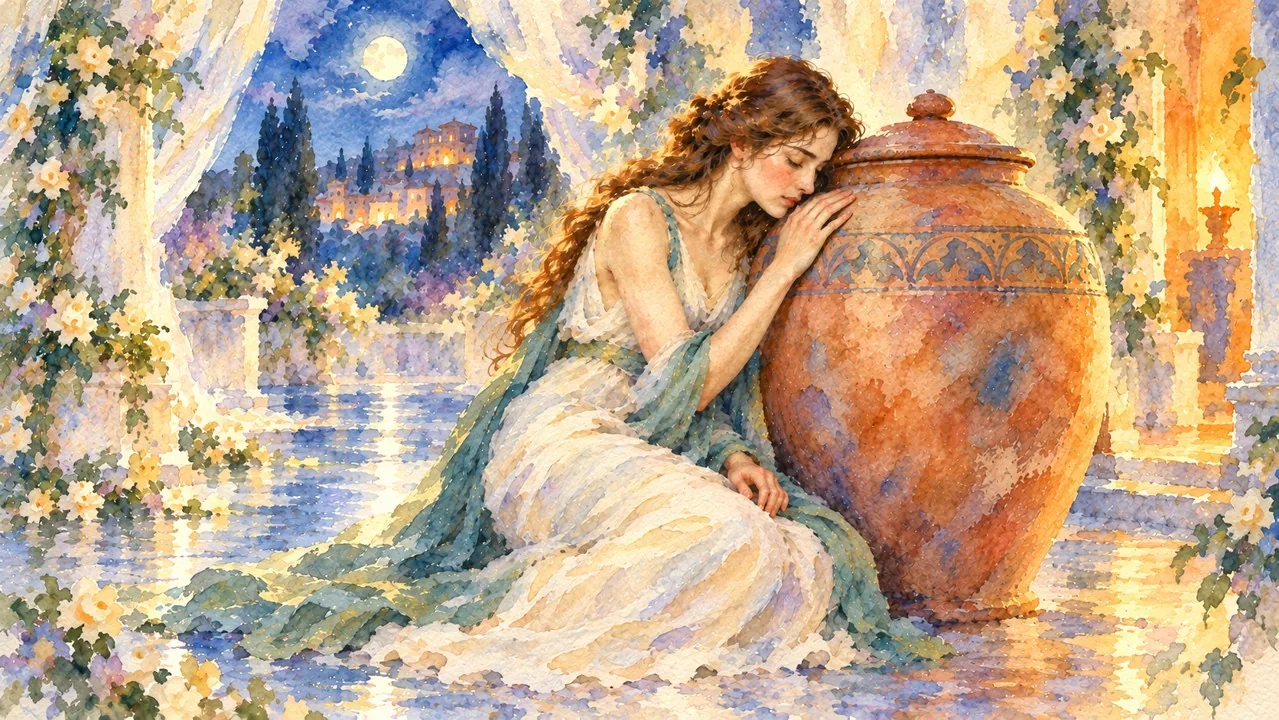
Brief Shapes film artwork: an artistic interpretation, not an archaeological reconstruction.
Sources & further reading
The ancient sources and our modern musical interpretation are distinguished below. This is an introduction to the cited traditions, not an exhaustive catalogue of every ancient reference.
- Hesiod · Works and Days42–105 · translated by H. G. Evelyn-White. Read the source ›
Creation and divine gifts, Epimetheus, the jar, released troubles and Hope remaining. - Hesiod · Theogony570–612 · translated by H. G. Evelyn-White. Read the source ›
The related creation-of-woman account, without the jar episode.
Beyond our artwork
The British Museum’s calyx-krater catalogue identifies Pandora as a completed female figure standing with wreaths in her hands. This ancient image concerns her making, not our invented ending beside the jar. The image stays on the external institution’s site; no reproduction rights are implied.
Pandora in ancient vase-painting ›
External museum record; its image remains on the institution’s website. No reproduction rights are implied.