 Brief Shapes
The extraordinary musician begins with an ordinary absence. The house is quiet in the wrong way. Our Orpheus carries his song beneath the earth, but the musical measures his loss through the small interruptions he remembers: somebody entering too early, teasing the performance, answering him. The person he wants is more than the audience his talent can summon.
A song that almost changes death
In Ovid’s Metamorphoses X, Eurydice dies from a snakebite shortly after her marriage. Orpheus descends to the underworld and sings before its rulers. His music interrupts the punishments of the dead and moves even the Furies. He may lead Eurydice back, on condition that he does not look behind him until the ascent is complete.
Near the upper world, fear and longing make him turn. Eurydice slips away a second time. He reaches but catches only air; she gives a barely audible farewell. Our film follows that failed return. The private memories and the exact emotional language of the song are inventions. It ends with the loss, rather than pretending to recount everything Ovid later tells about Orpheus.
Sources: Ovid.
Eurydice speaks differently
Virgil’s Georgics IV embeds the story in the misfortune of Aristaeus. Eurydice encounters the fatal snake while fleeing him. After Orpheus looks back, she speaks at greater length than in Ovid, lamenting the madness that has destroyed them both. The account goes on to Orpheus’s grief and violent death.
The difference matters. A brief farewell, a reproach and a retrospective lover’s narration do not give Eurydice exactly the same presence. Our musical takes Ovid’s return episode as its basis, while creating an earlier affectionate memory in which she has her own timing and wit. We do not present that memory as a recovered scene from either poet.
Sources: Virgil.
The voice that interrupts the perfect song
The opening memory refuses to make Eurydice merely the silent object of a rescue. She knows the ending and sings too soon. Orpheus may command trees and rivers, but she can gently puncture the solemnity of his performance. Her pleasure is not reverent applause. It is the ease of someone who belongs beside him.
This is why his wish to listen is as important as his ability to sing. A performer whose voice reaches everybody can still be bereft of one particular answer. The title’s one person is not an abstract ideal audience. She is the person whose interruption would be welcome.
The underworld temporarily responds to his extraordinary gift. For a moment, the story offers the possibility that art can achieve the impossible. We let that possibility matter instead of treating the failed return as obvious from the beginning. Hope makes the condition something he must actually live through, not simply a rule the audience waits for him to break.
On the ascent, the song imagines the fear that he might be walking alone. This is his inner experience or retrospective narration, not an invented audible conversation between the travellers: Ovid describes their path as silent. The distinction keeps the song’s expressive freedom from quietly rewriting the condition of the journey.
The turn does not need a villainous motive. It emerges from the same longing that brought him below. The aftermath is not a larger show of power but an unanswered space. In the final refrain, the wish to hear her remains, yet he can no longer make its fulfilment the next event in the song. Leaving room for her is not another resurrection spell.
Room around a solitary figure
The painted animatic gives the story an intimate scale inside an immense landscape. In the production concept, a seated Orpheus holds his lyre against pale stone while the dark water and distant ruins extend far beyond him. The setting can be vast without making his grief a public monument.
The invented affectionate memories provide a different kind of space: the felt size of the life that has disappeared. They are not evidence about ancient household customs. They are the film’s way of making loss particular, through habits rather than a general declaration that two people were in love.
This interpretation does not promise that beauty repairs death. It asks what music can hold when it cannot restore the person it names. The ending keeps that question open, with tenderness rather than a new miracle. A song can continue to make room for somebody without pretending that the empty place has been filled.
A Song for One
One brief shape.
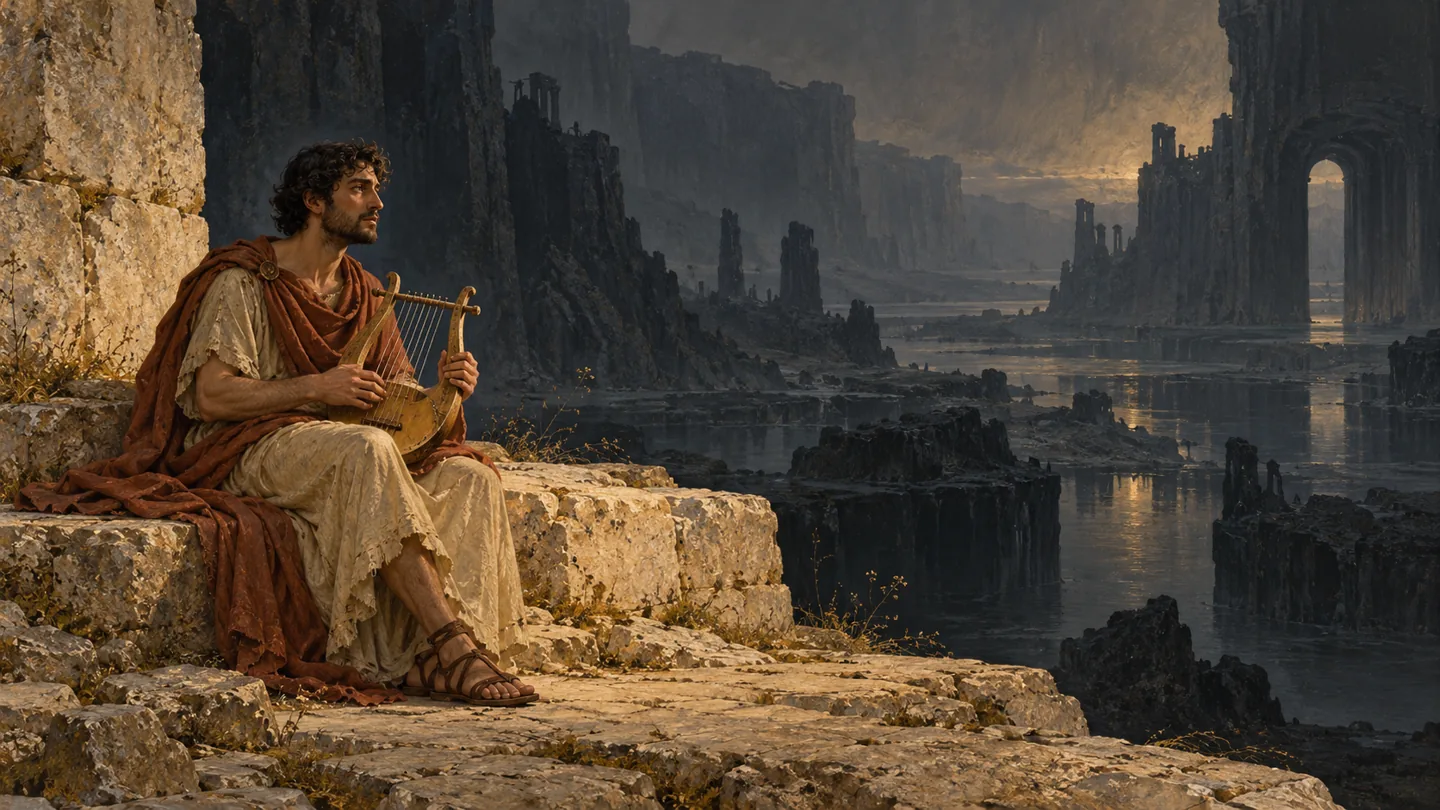
Brief Shapes film artwork: an artistic interpretation, not an archaeological reconstruction.
Sources & further reading
Ancient accounts and the original situation created for this musical are distinguished below. This introduction follows selected surviving sources; it is not an exhaustive catalogue of every tradition.
- Ovid · Metamorphoses10.1–85 · translated by Brookes More. Read the source ›
The failed return, silent ascent, backward glance and brief farewell. - Virgil · Georgics4.453–527 · translated by H. R. Fairclough. Read the source ›
The Aristaeus frame and Eurydice’s longer farewell in a distinct Roman telling.
Beyond our artwork
Bowdoin’s 1914.8.2 is a nineteenth-century plaster cast after a Roman relief in Naples, not itself an ancient marble. The museum page explains the parting image and the history of teaching with casts.
The parting in relief—and a later cast ›
External museum record; its image remains on the institution’s website. No reproduction rights are implied.