 Brief Shapes
Left, Right, Wrong Again begins with the ingredients of a frightening entrance: echoing footsteps, an enormous shadow, a creature approaching through stone corridors. Then it gives that creature a thoroughly unheroic purpose. Breakfast should not require an expedition. Our Minotaur is caught in a building whose reputation for complexity is much less impressive when you have to live in it.
The labyrinth was a prison
Apollodorus’s Library connects the Minotaur’s birth to Minos’s failure to sacrifice Poseidon’s bull. Pasiphae’s desire and Daedalus’s wooden cow precede the birth of Asterius, called the Minotaur. Minos confines the bull-faced, human-bodied creature in Daedalus’s labyrinth.
The Epitome places Theseus within the Athenian tribute sent to Crete. With Ariadne’s help he enters the maze, kills the Minotaur and retraces the thread to escape. This is a violent story of tribute, confinement and a hero’s victory, not an ancient account of a friendly resident searching for a kitchen.
Sources: Apollodorus, Apollodorus.
Even antiquity changed the frame
Plutarch also records rationalizing accounts in which the monstrous opponent becomes Taurus, a powerful man associated with Minos. One version has Theseus defeat him at games; another reports a naval fight. These are alternative explanations collected by an ancient writer, not evidence that every telling secretly describes the same literal event.
Our musical takes a different freedom. It retains the familiar creature and the maze, but invents an ordinary working day inside them. It is neither a reconstruction of Taurus’s story nor a claim to have recovered the Minotaur’s forgotten testimony. The difference is openly part of the pleasure.
Sources: Plutarch.
The wrong turn that becomes a refrain
The original song repeatedly sends its enormous protagonist past the same landmarks. A pillar, an arch and a stair ought to lead somewhere new; instead, a familiar cracked vase announces another failed circuit. The repeated chorus is both a musical hook and the architecture of the joke. We recognize the return before the frustrated walker has quite accepted it.
A would-be hero arrives with a sword and a confident demand for directions. The visitor is deliberately unnamed: this episode should not be presented as a new account of Theseus’s encounter. For a moment, the expected contest between hero and monster is replaced by two people who cannot navigate the same corridor. Confidence proves no more useful than size.
The song then changes its listening distance. Our Minotaur hears signs of life above him—passing movement, laughter, weather—and admits to wanting a small choice of his own. These feelings and the details that express them are original characterization. They do not erase the victims in the ancient tradition, because the film is not proposing that its breakfast comedy is a comprehensive or historically corrective version of that tradition.
The practical breakthrough is chalk. He marks the route, reaches food and manages to retrace his steps. This is intentionally smaller than breaking the labyrinth or defeating its ruler. The ending does not release him from captivity, make the walls benevolent or suggest that confinement is acceptable if one learns to enjoy it. He achieves one repeatable journey within conditions he did not choose.
Great stone, small plate
The existing promotional artwork places a powerful bull-headed figure in a dark corridor, holding a plate. The proportions supply the joke before a lyric begins: a body designed for an epic confrontation is occupied by an everyday inconvenience. Deep reds and torchlit stone preserve the theatrical atmosphere instead of turning the labyrinth into a cheerful playroom.
The chalk in the song is a deliberately modest answer to that scale. Ariadne’s thread guides another traveller through the same legendary kind of space; our Minotaur’s marks give its inhabitant a way to remember. That parallel is a reading of the two Brief Shapes films, not an additional episode from an ancient text. Both make practical attention matter more than heroic volume.
Home again is not the same as wrong again
The musical resolves by changing what a repeated place means. At first, arriving back where he started demonstrates failure. Once he can choose and retrace a route, returning becomes an achievement. The maze remains, but a small part of his experience is no longer entirely accidental.
That is the tenderness under the absurdity. We are not asked to admire a great conquest. We are allowed to notice the relief of an ordinary task finally accomplished. An empty plate, a mark on stone and a remembered turn can carry a story without pretending to solve every cruelty surrounding it.
Minotaur: Left, Right, Wrong Again
One brief shape.
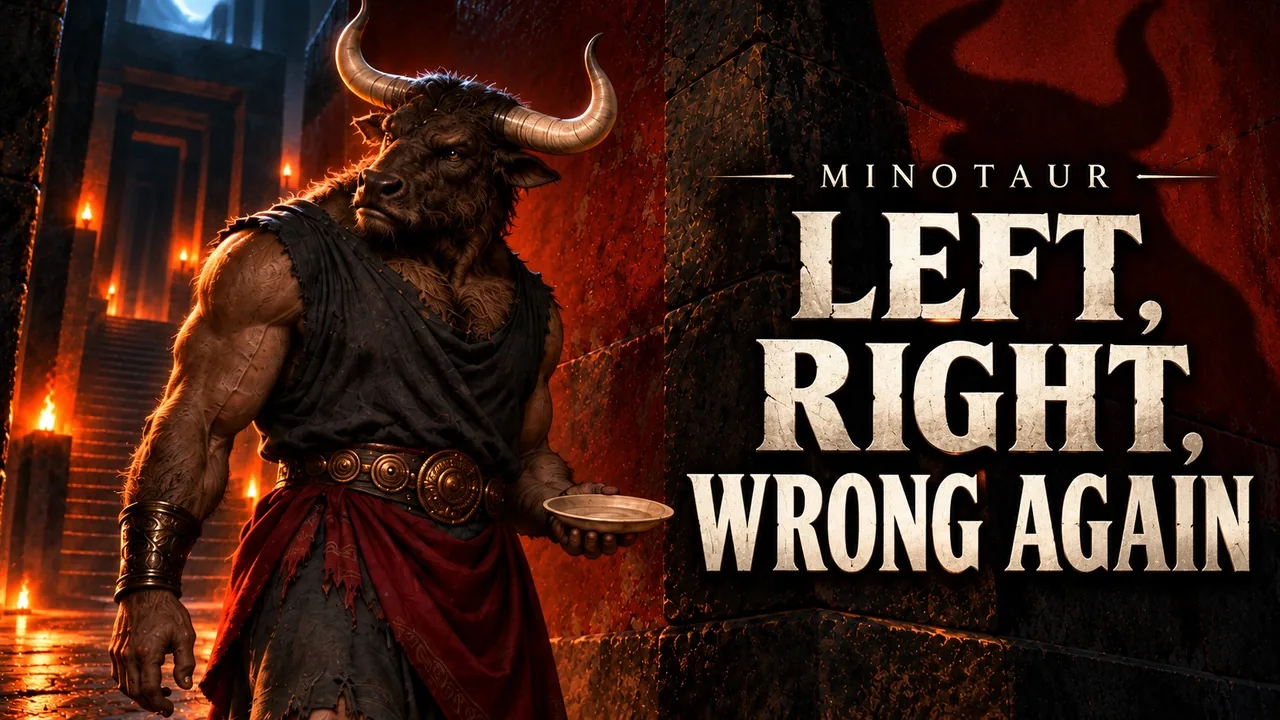
Brief Shapes film artwork: an artistic interpretation, not an archaeological reconstruction.
Sources & further reading
An introduction to the cited ancient traditions, distinguished from the original lyrics, comic situations and visual choices of our film. Not an exhaustive record of every ancient reference.
- Apollodorus · LibraryIII.1.4 · translated by J. G. Frazer. Read the source ›
Birth, name and confinement of the Minotaur. - Apollodorus · EpitomeI.7–9 · translated by J. G. Frazer. Read the source ›
Tribute, Theseus, Ariadne’s thread and the Minotaur’s death. - Plutarch · Life of Theseus19.2–3 · translated by Bernadotte Perrin. Read the source ›
Alternative rationalizing accounts involving Taurus.
Beyond our artwork
The Metropolitan Museum of Art, object 76.12.7, attributed to the Pan Painter, ca. 470–460 BCE. Theseus and the Minotaur appear on opposing sides of the vessel. External museum link; no image copied.
Theseus and the Minotaur on a terracotta skyphos ›
External museum record; its image remains on the institution’s website. No reproduction rights are implied.