 Brief Shapes
There is a moment when an apparently perfect gift reveals its terms. For Midas, it happens at the table. Wealth has filled his world and emptied it of things he can use. Our musical follows the excitement long enough to let the audience understand its appeal, then lets an ordinary human need interrupt the fantasy. A king may own everything in sight and still be hungry.
A reward that becomes a trap
In Ovid’s Metamorphoses, Midas welcomes Silenus and returns him to Bacchus, the Roman name used here for Dionysus. The grateful god offers a reward. Midas asks that whatever he touches become gold. The request is granted, and he tests his new power with delight. But bread, meat and drink become inedible treasure. Terrified by hunger and thirst, he begs for release. Bacchus sends him to wash at the source of the Pactolus; the golden power leaves his body and enters the river.
Ovid follows the episode with another failure of judgment: Midas objects when the mountain Tmolus awards a musical contest to Apollo rather than Pan, and receives an ass’s ears. That is a separate episode, not the punishment for the golden wish. Our film concentrates on the touch, the meal and the river rather than combining the two ordeals.
Sources: Ovid.
The small figure at the water
Nicolas Poussin’s Midas Washing at the Source of the Pactolus, now at the Metropolitan Museum of Art, offers another artist’s selection from the same story. Its catalogue dates the painting to about 1627. Midas appears behind a reclining river figure, diminished rather than triumphant. The scene chooses the remedy, not the dazzling first success.
This painting is a later European interpretation, not an ancient illustration. It is included here as a useful comparison: artists can change the emotional centre of a myth simply by deciding where to pause. Our film takes more time with the king’s appetite before arriving at the humbling water.
Sources: The Metropolitan Museum of Art.
The appetite behind the wish
The production’s story moves from hospitality and the wish into a spree of transformations, then to a banquet nobody can enjoy. A ruined rose belongs to that progression. Beauty becomes possession, but possession no longer preserves what made the thing desirable. Gold has not improved every object; it has made unlike things disastrously alike.
The comic rhythm matters. Midas is not introduced merely to be scolded. His escalating pleasure makes the wish feel like a temptation with momentum. There is always one more object to transform, one more proof that the bargain works. The title captures that expanding horizon: enough keeps moving whenever he approaches it.
At the banquet, the joke exposes a bodily limit. The gleam remains, while the purpose of the meal disappears. Our account of the film stays with that collision between value and usefulness, rather than adding a daughter transformed to gold or other incidents not supported by this production. The ancient episode already gives a very powerful reversal without them.
The prayer and the river offer a way back, but our visual continuity keeps the remedy precise. Losing the touch does not automatically turn all the palace’s golden objects back into their former materials. The final ordinary bread belongs at a separate plain wooden table. That small change of setting lets the relief feel physical: not a palace magically tidied, but a meal that can finally be eaten.
Then comes a last temptation. The production’s closing question about the river’s sand leaves a little uncertainty inside the lesson. Has Midas learned to want differently, or simply found a new object for the same desire? That comic hesitation is our emphasis, not a claim that Ovid ends the golden-touch episode with the film’s exact exchange.
Tarnished gold, not a golden world
The film uses a severe illustrated language: ink-like marks, cold shadows and muted, tarnished gold. The selected artwork places the crowned king among abundance, his hand resting on a pear as its surface changes. The transformation is attractive and uncomfortable at once. It is still recognisably food, just as it is ceasing to be food.
That contrast plays against the song’s comic swing. The pictures need not become cheerful to carry humour, and the music need not become a sermon to carry consequences. The pleasure of the telling and the danger of the wish can occupy the same moment.
An ordinary piece of bread
Brief Shapes often gives a grand myth a small point of contact. Here it is not the throne but the table. Hunger makes the king legible without requiring the audience to share his wealth, and relief can be measured in something simpler than another treasure.
The film leaves room for both tenderness and a raised eyebrow. Midas may have changed, but wanting is a persistent habit. A little laughter at the ending keeps that question open: what do we actually hope to receive when we ask for more?
Midas: Just One More
One brief shape.
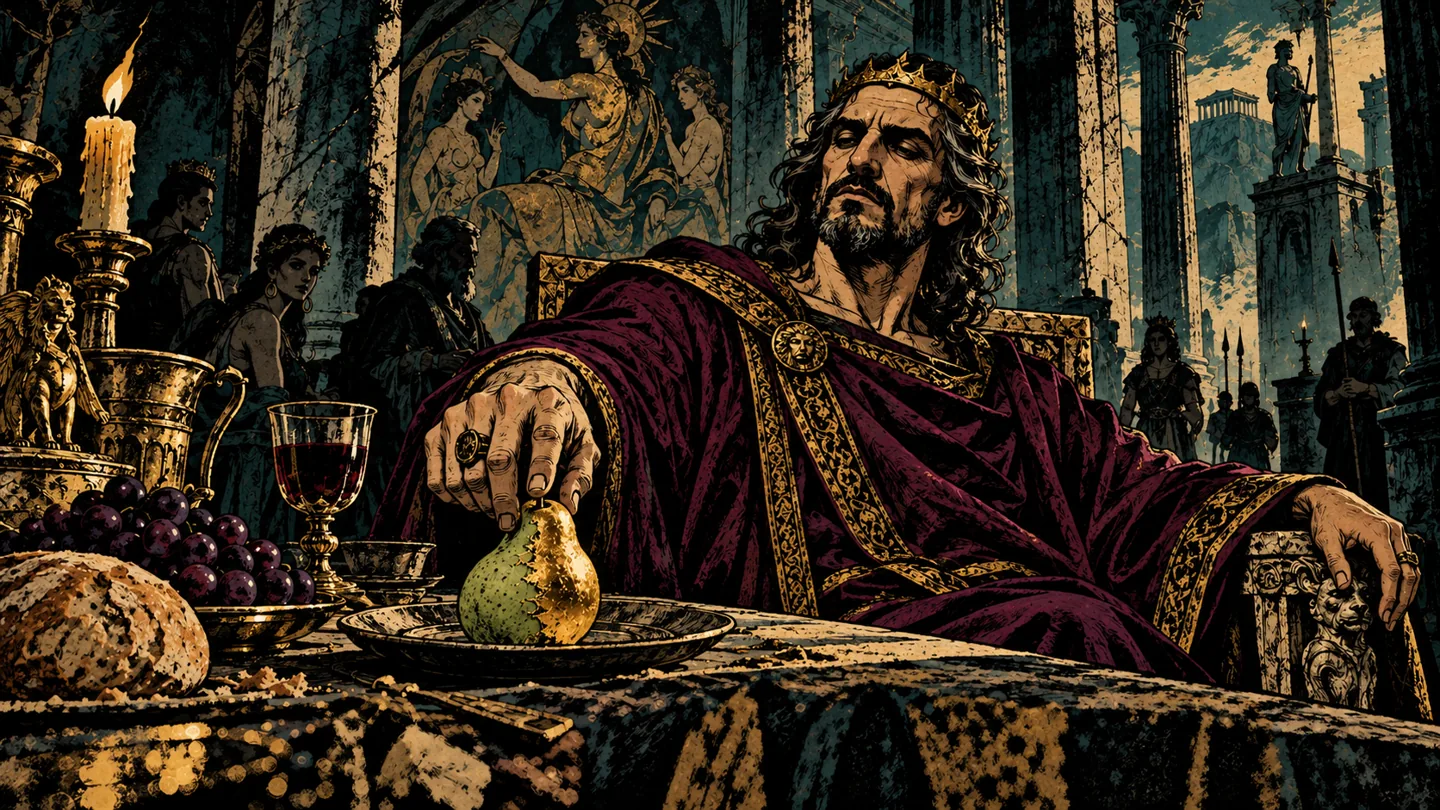
Brief Shapes film artwork: an artistic interpretation, not an archaeological reconstruction.
Sources & further reading
This entry distinguishes Ovid’s ancient sequence, a later painting and the original comic staging of our musical.
- Ovid · Metamorphoses11.85–145; the separate musical contest follows at 11.146–193 · translated by Brookes More. Read the source ›
Bacchus, Midas, the golden touch and the Pactolus; the following episode concerns Pan, Apollo and the ass’s ears. - The Metropolitan Museum of Art · Midas Washing at the Source of the PactolusNicolas Poussin, ca. 1627; object 71.56. Read the source ›
A later artistic reception of the myth, with an illustrated collection record.
Beyond our artwork
A seventeenth-century response to the ancient tale. This is later reception, not ancient evidence or a source for the film’s artwork.
View Poussin’s Midas at The Met ›
External museum record; its image remains on the institution’s website. No reproduction rights are implied.