 Brief Shapes
The traditional rescue needs three familiar roles: the endangered princess, the heroic rescuer and the monster that must die. Our film begins inside that arrangement, then lets the supposed obstacle think. Ketos has been given an assignment, not an ethical argument. When Andromeda offers her chained hands, the enormous creature has to decide whether his strength belongs to whoever ordered him to use it. The result is a comedy that discovers something serious inside its own joke.
A daughter pays for a boast
In the Library attributed to Apollodorus, Cassiopeia claims to surpass the Nereids in beauty. Their anger brings Poseidon’s flood and sea monster upon the land ruled by Cepheus. An oracle declares that the disaster will end if Andromeda is exposed to the creature. Her father yields to public pressure and binds her to a rock. The daughter is made to pay for the mother’s words.
Perseus arrives, falls in love with Andromeda and obtains a promise of marriage from Cepheus before fighting. He kills the monster and releases her. A subsequent plot by her earlier betrothed, Phineus, ends with Perseus turning the conspirators to stone with Medusa’s head. This account distinguishes the monster’s killing from that later use of the Gorgon. Our film does not reproduce its outcome.
Sources: Pseudo-Apollodorus.
Not every monster meets the same weapon
Ovid gives the encounter a prolonged aerial battle. Perseus attacks with his sword, dodges the creature’s jaws and finally gains purchase on a rock. The monster dies, Andromeda is freed and her parents celebrate. In this telling the Gorgon’s head is not the weapon that ends the sea battle.
Other ancient retellings differ. Nonnus’s Dionysiaca describes the sea monster being petrified. These versions share a defeated creature but not an identical fight. Neither supplies our peaceful refusal. Ketos is a Greek word for a great sea creature or monster; here we use it as our character’s name. He is not a Titan, and the film is not an adaptation of the Scandinavian Kraken.
The teeth are his to use
Our departure is deliberate and announced in the title: A Different Ending. We keep the boast, divine punishment and chained young woman as the starting situation. We invent the monster’s conscience, Andromeda’s trust and the possibility that the required fight simply need not happen. This is not a newly discovered ancient variant.
The comedy initially comes from scale. A creature built to terrify is surrounded by people who are extremely confident that somebody else should do the unpleasant work. Gods point and royalty expects compliance. Ketos’s immense face makes room for an unexpectedly ordinary response: reluctance. The supposed instrument of punishment becomes the one participant willing to question the arrangement.
Andromeda is not merely transferred from one protector to another. She offers her chains to the creature that was sent to consume her, making an active and dangerous choice. The mouth that could destroy her instead breaks a link. The meaning of those teeth changes without their becoming smaller or less formidable. Strength is still present; its purpose has changed.
Perseus arrives prepared for his heroic part, but the scene no longer needs the expected performance. Andromeda interrupts it. The peaceful outcome is not proof that there was never a threat: it is the consequence of refusing the assigned roles. Her remaining cuffs and broken chain ends matter visually because freedom has a history. The film does not pretend she was never bound.
The emotional turn is therefore larger than a joke about a misunderstood animal. Ketos does not simply discover that he is secretly harmless. He decides how to act when obedience would be easier to explain. Andromeda meets that decision with her own. The story becomes epic at the precise point where it stops trying to produce a conventional heroic victory.
A comic face, a consequential choice
Bright painted skies, turquoise water and emphatic expressions keep the film in an openly illustrated world. Ketos’s heavy eyelids and enormous muzzle can carry a joke before anyone sings. Close views of his eye slow the spectacle down: the threatening silhouette becomes a face capable of considering another person.
The finished film combines held illustrations with selected animated moments. Its visual exuberance is not an archaeological claim. We wanted the grandeur and the absurdity to coexist, so that the choice to disobey could arrive without the film abandoning its comic beginnings. The monster does not have to stop looking like a monster to deserve a different ending.
Ketos: A Different Ending
One brief shape.
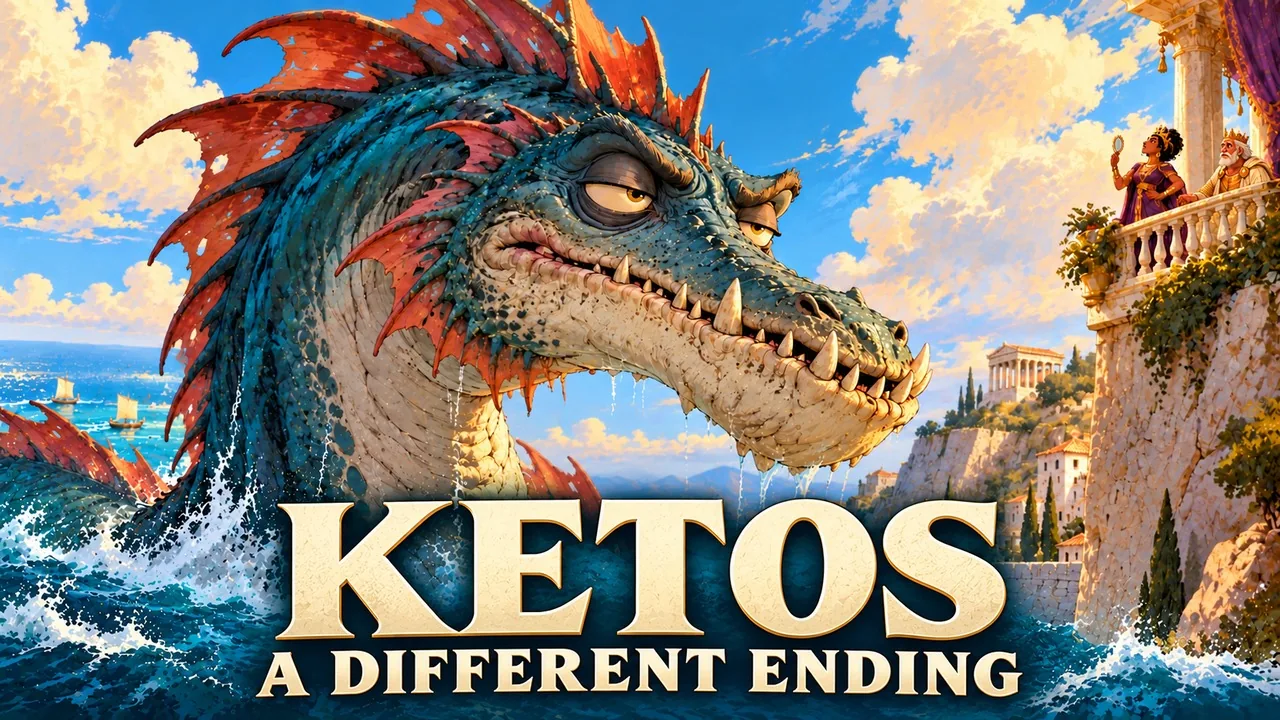
Brief Shapes film artwork: an artistic interpretation, not an archaeological reconstruction.
Sources & further reading
An introduction to the cited ancient accounts and the distinct choices of our film, not an exhaustive catalogue of every surviving tradition.
- Pseudo-Apollodorus · LibraryII.4.3 · translated by J. G. Frazer. Read the source ›
Cassiopeia, the sacrifice, Perseus’s bargain and the killing of the monster. - Ovid · MetamorphosesIV.663–739 · translated by Brookes More. Read the source ›
The rescue and detailed sword fight; the full-text translation differs from excerpts elsewhere on Theoi. - Nonnus · DionysiacaXXV.80; XXX.273; XLVII.510 · translated by W. H. D. Rouse. Read the source ›
Primary-text excerpts collected on Theoi document the petrification variant. This link also supplies Greek and Latin name forms.
Beyond our artwork
The Metropolitan Museum’s Roman fresco, dated to the last decade of the first century BCE, presents the rescue and its aftermath. Object 20.192.16. An ancient visual interpretation, not an image from our alternative ending; view the artwork on the museum’s site.
Perseus and Andromeda at Boscotrecase ›
External museum record; its image remains on the institution’s website. No reproduction rights are implied.