 Brief Shapes
The familiar image is a boy falling out of the sky. Our film begins before that image has become inevitable: with a workbench, a father, a son, and the intimacy of making things together. A Little Higher keeps the tragedy, but asks the viewer to feel the relationship that the fall will break. The wings are first an act of care, and only later the shape of a catastrophe.
The air that Minos cannot close
In Ovid’s Metamorphoses VIII.183–235, Daedalus longs to leave Crete. Minos controls routes by land and sea, so the craftsman turns to the air. He arranges feathers, fastens them with thread and wax, and builds wings for himself and Icarus. He warns his son to follow a middle course: the sea threatens low flight, the sun threatens high flight. Icarus delights in flying, climbs, loses the wax-bound feathers and falls into the sea. Daedalus calls for him, finds the remains and buries him.
Ovid places this after the Labyrinth narrative, but the flight passage itself describes detention on Crete, not a detailed prison escape from a roofless maze. Its tenderness is already considerable: Daedalus’s hands shake as he fits the wings, and his instruction carries the anxiety of a parent who knows the danger.
Sources: Ovid.
An escape from the maker’s own design
The Library traditionally attributed to Apollodorus is more explicit. In Epitome 1.12–13, Minos imprisons Daedalus and Icarus in the Labyrinth after Theseus escapes. Daedalus constructs wings and warns against sun and damp; Icarus flies too high and dies. Daedalus reaches Sicily. This account supports placing our father and son inside the Labyrinth before their departure.
The precise workcourt, the secret preparation and the climb to the wall top are visual inventions. We distinguish that staging from the ancient claim of imprisonment. The film draws on compatible parts of the two accounts without presenting its own architectural arrangement as something described by either author.
Sources: Pseudo-Apollodorus.
The space beside a father’s chair
Our emphasis is not on punishing a foolish child. The childhood workbench gives the later flight a history. Making is how these two people spend time together, and the father’s extraordinary invention grows from a familiar desire to protect and provide. That makes the danger more intimate than a general moral about ambition.
The journey through captivity matters as well. The sky is not merely a tempting place to show off: it is the opening that might allow them to live freely. The Labyrinth images make the contrast physical. Below them are walls, confinement and repeated turns; ahead is a horizon without corridors. The exhilaration is understandable even when the viewer knows the ending.
The film includes a failed rescue rather than treating the fall as an impersonal emblem. It stays with the father after the flight has ceased to be a triumph. The concluding workshop is a lyrical remembrance, not a claim that Daedalus returned to Minos’s custody. A small mechanical bird carries the memory of their shared work. That object is our addition to the myth.
The mechanical details also belong to our interpretation. We wanted a slight fantastical engineering quality, but not a claim that ancient authors describe elaborate modern mechanisms. The wings retain their vulnerability. Their ingenuity is real within the film’s world; it does not turn them into a guarantee.
This is why the title can hold more than one feeling. Height offers wonder and escape, but the desire for a little more has a cost that cannot be negotiated afterward. The father’s grief does not cancel the beauty of the moment when both were airborne. Nor does that beauty make the loss acceptable. The film leaves those truths beside one another.
A world made by hand
Charcoal, rough paper and unfinished edges keep the film close to drawing rather than polished spectacle. The selected image shows father and son above the maze, facing the sea with their engineered wings spread. It is an illustration of our adaptation, not a reconstruction of ancient technology.
The animatic uses slow pushes, pullbacks and changes of scale to move through its still illustrations. Shorter images carry the failure of flight, while grief is allowed to linger. Economical detail makes the empty spaces noticeable: the unoccupied place beside a chair can become as expressive as a figure.
Brief Shapes often gives immortals brief human moments. Here the characters are mortal, and time together is the fragile thing. What remains at the end is not a successful machine or a victory over a king, but the memory of hands that once worked side by side.
A Little Higher
One brief shape.
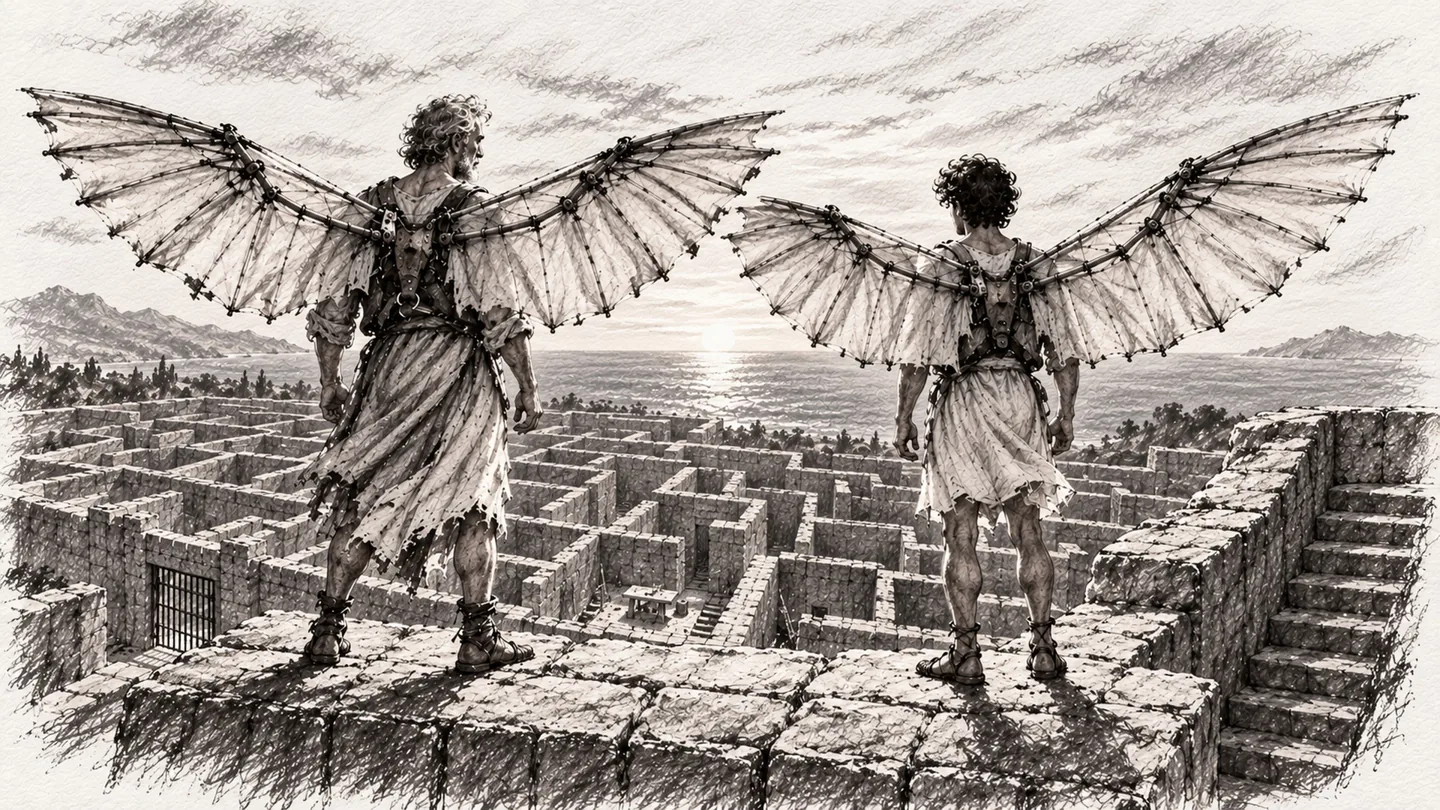
Brief Shapes film artwork: an artistic interpretation, not an archaeological reconstruction.
Sources & further reading
The ancient sources and our modern musical interpretation are distinguished below. This is an introduction to the cited traditions, not an exhaustive catalogue of every ancient reference.
- Ovid · MetamorphosesVIII.183–235; Labyrinth context VIII.152–182 · translated by Brookes More. Read the source ›
The construction of the wings, warning, flight, fall and mourning. - Pseudo-Apollodorus · Library, Epitome1.12–13 · translated by J. G. Frazer. Read the source ›
The explicit tradition of imprisonment in the Labyrinth before the flight.
Beyond our artwork
Dickinson College Commentaries illustrates an Apulian red-figure calyx-krater fragment with Daedalus and the dead Icarus, British Museum 2007,5004.1. This ancient object offers a different visual emphasis from our charcoal flight scene. The image stays on the external institution’s site; no reproduction rights are implied.
Daedalus and Icarus on an ancient vessel ›
External museum record; its image remains on the institution’s website. No reproduction rights are implied.