 Brief Shapes
Heracles arrives with a formidable reputation and a simple plan: be formidable. The Hydra makes that plan worse every time he applies it. Our musical takes a labour in which help is essential and gives the difficulty of asking for that help its own dramatic weight. The monster multiplies; the hero’s idea of himself must change.
A labour that requires two people
Pseudo-Apollodorus describes the Lernaean Hydra as a nine-headed creature, with one immortal head. Heracles finds that smashing a head produces two replacements. Iolaus burns the severed roots, stopping their renewal; Heracles buries the immortal head beneath a heavy rock. Eurystheus then refuses to count the labour because Heracles received assistance. The ancient account already contains an awkward difference between accomplishing the task and satisfying the official definition of a solo achievement.
That is the foundation of our episode, not an invented solution added to improve the myth. The comic singing heads and the hero’s extended resistance to sharing his moment belong to our musical. The action is a selected labour, not a complete life of Heracles or a retelling of all twelve tasks.
Sources: Pseudo-Apollodorus.
How many heads make a nightmare?
Diodorus Siculus offers a notably larger Hydra: a single body with a hundred serpent-bearing necks. In Library of History 4.11.5–6, Heracles devises the solution and directs Iolaus to cauterize each severed place. Assistance remains part of the victory, although the distribution of ingenuity differs from a reading that gives Iolaus the whole idea.
The number of heads is therefore not a fixed detail shared by every surviving account. Our story uses the recognizable pattern of cutting, regrowth and sealing; its emotional argument does not depend on claiming that one ancient inventory is the only correct one. The film’s carefully designed creature is an artistic version, not a zoological reconstruction.
Sources: Diodorus Siculus.
The unwanted backing singers
The musical turns regeneration into a terrible accompaniment. Heracles expects a heroic solo; the Hydra’s multiplying heads answer with multiplying voices. His confidence does not simply meet a larger opponent. It actively produces a larger problem.
That repetition makes room for comedy without removing the danger. A person can be impressively capable and still trapped by the insistence that capability must be displayed alone. The title describes a position he begins with, rather than the lesson we want the audience to carry away.
Iolaus is not a replacement hero sent to make Heracles irrelevant. Their abilities work together. Strength still matters, but so do observation, fire, timing and the willingness to stand beside somebody rather than in front of them. The shift from individual performance to coordinated action is the change the song asks us to notice.
The ancient refusal to credit assisted work gives that change an extra edge. We are interested in a victory that need not become less real because an authority dislikes the way it was achieved. A monster has been overcome. Two people did something that one person, repeating the same gesture, could not do. The official arithmetic does not have to be the final measure of its value.
An ancient nightmare with a human scale
The finished production’s promotional artwork places black and gold figures against a fierce red field: two small people beneath an enormous spread of serpentine necks. Its carved, patterned surfaces and antique-looking silhouettes are a stylized visual language, not a copy of an excavated painting. The colour can make an absurd musical premise feel genuinely dangerous.
The central contrast is not merely between man and monster. It is between the immense creature filling the image and the small adjustment in the hero’s attitude that allows the action to change. We can give the Hydra spectacle while reserving the emotional climax for an invitation to help.
This is why the quieter idea matters alongside the enormous labour. Brief Shapes often finds its story in a moment that a conventional triumph might pass over: a look toward the person waiting nearby, a relinquished boast, enough space for another pair of hands. The hero does not have to become weaker to become less alone. Nor does accepting help require him to stop being brave. The courage changes its object: for a moment, it is directed at the picture he has been carrying of himself.
I Can Do It Myself
One brief shape.
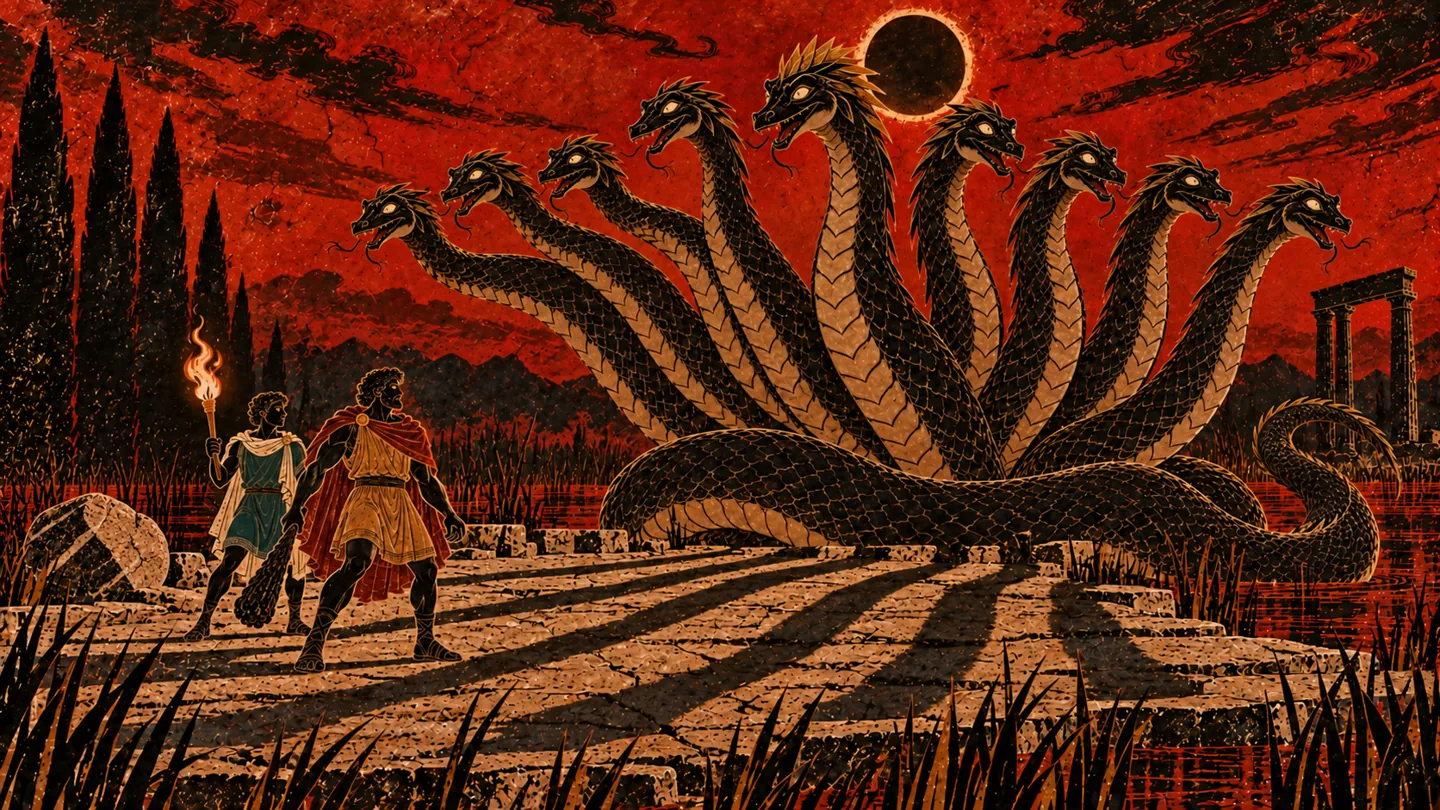
Brief Shapes film artwork: an artistic interpretation, not an archaeological reconstruction.
Sources & further reading
Ancient accounts and the original situation created for this musical are distinguished below. This introduction follows selected surviving sources; it is not an exhaustive catalogue of every tradition.
- Pseudo-Apollodorus · Library2.5.2 · translated by J. G. Frazer. Read the source ›
Nine heads, Iolaus’s fire, the buried immortal head and Eurystheus’s refusal to count the assisted labour. - Diodorus Siculus · Library of History4.11.5–6 · translated by C. H. Oldfather. Read the source ›
A hundred-necked Hydra and Heracles directing Iolaus to cauterize the wounds.
Beyond our artwork
British Museum hydria, museum number 1843,1103.73. Explore the museum’s record and images for an ancient representation of Herakles; the external artwork is not reproduced on this page.
Herakles in ancient vase painting ›
External museum record; its image remains on the institution’s website. No reproduction rights are implied.