 Brief Shapes
What does the maker of divine wonders make for himself? Our Hephaestus is neither a failed god waiting for recognition nor a machine that exists to fulfil other people’s wishes. He is very good at his work. The problem is that everybody knows it. The Bird and I gives the great craftsman an ordinary, recognisable difficulty: finding a little room for pleasure among the commissions.
A workshop full of wonders
In Iliad XVIII, Thetis visits Hephaestus to ask for new armour for Achilles. She finds him building twenty wheeled tripods capable of travelling to the gods’ assembly and returning independently. Golden female attendants possess intelligence, speech, strength and practical skill. The workshop is a place of invention as well as hard physical labour. Later, the god makes Achilles’ extraordinary shield.
Hephaestus also remembers being rescued by Thetis and Eurynome after Hera rejected him because of his disability. For nine years he worked in their sea-cave. That relationship gives Thetis’s arrival a personal history: this is not simply a customer approaching a supplier.
Sources: Homer.
More than one account of a fall
Iliad I supplies a different remembered fall: Hephaestus says Zeus hurled him from heaven when he tried to protect Hera. He landed on Lemnos and was cared for by the Sintians. We should not flatten these recollections into a single incident with interchangeable causes.
The short Homeric Hymn to Hephaestus praises him alongside Athena as a teacher of crafts that make human life more secure. Its subject is skill as a shared benefit, not a comic bird or an unhappy customer. Together these texts offer different entrances to the same divine figure: invention, vulnerability, obligation and useful knowledge.
The commission that can wait
Our musical borrows the self-moving tripods and capable golden helpers, then invents a working day around them. The queue of requests, late revisions, water-tank misunderstanding and ignored warning lever are original comedy. They are not lost incidents from Homer. Nor is this film a retelling of the making of Achilles’ armour.
The bronze bird is the centre of that invention. Made from scraps, it is small enough to sit beside the work of a god without competing with it. Its irregular wing and peculiar clattering note make it distinct, not worthless. Hephaestus initially sets it aside when another demand arrives. The significant action comes later, when he reaches to improve its sound and decides not to.
This is not a lesson that craftsmanship does not matter. The film depends on his competence: he understands his mechanisms, stops the dangerous runaway tripod and works with helpers who know what they are doing. His freedom lies in choosing what requires correction and what he simply enjoys. A personal creation need not pass the same test as a commission.
The refrain changes with that decision. What begins as a rueful rhythm of service becomes something he can answer with a whistle. The bird does not have to become flawless, famous or useful to anyone else. Neither does a customer need to discover his hidden value. He can put down the tool without waiting for applause.
Warmth at the edge of the furnace
The production places this small relationship inside a substantial forge: dark stone, bronze, worn surfaces and amber light. The contrast in scale matters. Around the maker are all the things that signal monumental work; directly in front of him is an object that asks for attention rather than admiration. The promotional image makes that relationship immediate, bringing a weathered face and a tiny metal bird into the same warm space.
His disability is not the joke and is not something the narrative promises to cure. Nor should the bird’s irregularity be treated as a disguised verdict on his body. The comedy belongs to impatient customers and misused machinery. The tenderness belongs to a capable person making a choice about his own time.
Off the clock
The ending is deliberately modest. There will still be another request tomorrow. An immortal craftsman has not solved work forever; he has claimed one interval within it. That is enough for a Brief Shapes story. A hundred spectacular objects may leave the workshop, while the imperfect one stays and makes its maker happy.
Watch for the change from producing a sound to listening to it. The same clank can be an irritation, a signature, or an invitation to answer. Nothing in the object needs to change for the moment between maker and creation to become something different.
Hephaestus: The Bird and I
One brief shape.
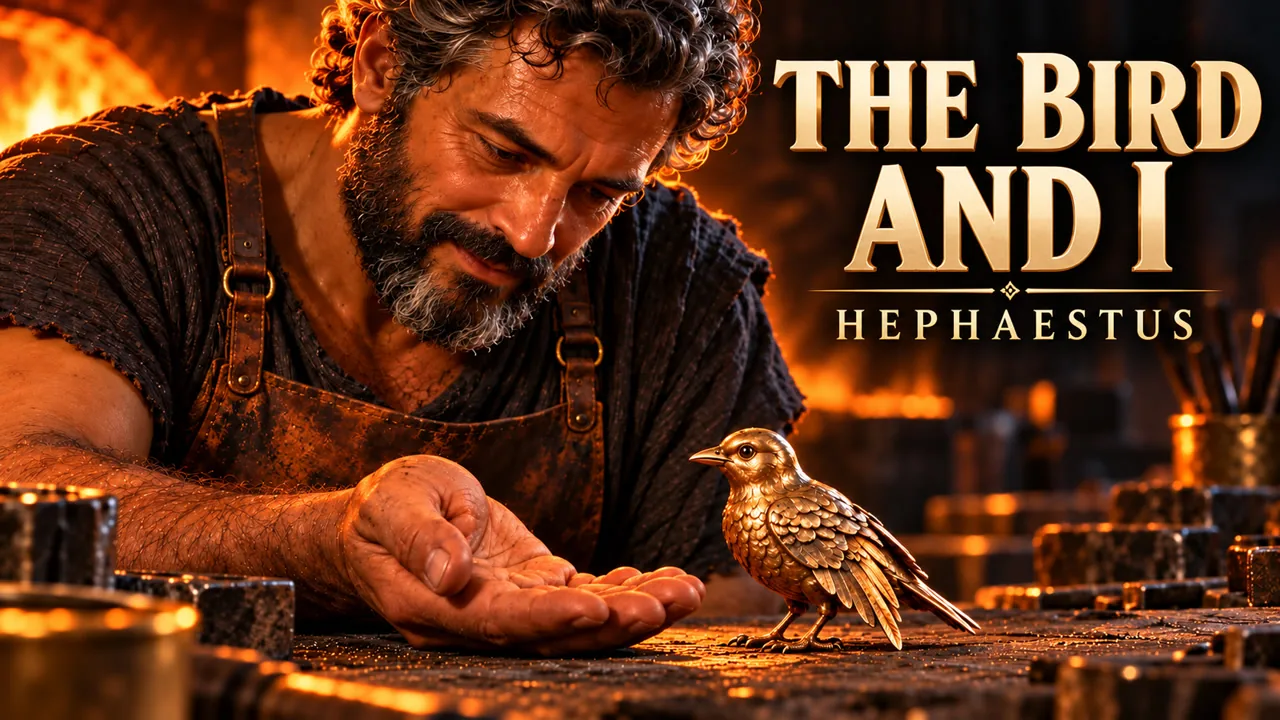
Brief Shapes film artwork: an artistic interpretation, not an archaeological reconstruction.
Sources & further reading
An introduction to the cited ancient traditions, distinguished from the original lyrics, comic situations and visual choices of our film. Not an exhaustive record of every ancient reference.
- Homer · IliadXVIII.368–421, 468–617 · translated by A. T. Murray. Read the source ›
The forge, self-moving tripods, golden attendants, Thetis and Achilles’ armour. - Homer · IliadI.568–611 · translated by A. T. Murray. Read the source ›
Hephaestus recalls Zeus throwing him to Lemnos. - Anonymous · Homeric Hymn 20 to HephaestusLines 1–8 · translated by H. G. Evelyn-White. Read the source ›
Hephaestus and Athena as teachers of human crafts.
Beyond our artwork
Kunsthistorisches Museum, Vienna. An external museum record of another episode in Hephaestus’s mythology, not the story of our bird. External link only; no museum image reproduced.
The return of Hephaestus to Olympus ›
External museum record; its image remains on the institution’s website. No reproduction rights are implied.