 Brief Shapes
Persephone brings a modest proposal to an establishment built for permanence. A little soil, somewhere to sit, a living thing beside the dead: none of it sounds revolutionary until somebody has to move the furniture. Our musical imagines a later encounter in the underworld. It does not pretend that a garden changes how Persephone first arrived there.
The mother, the daughter and the bargain
The Homeric Hymn to Demeter begins with Hades abducting Persephone with Zeus’s consent. Demeter searches for her daughter, withdraws from the gods and prevents the earth from bearing crops. The resulting famine forces a response. Hermes is sent to bring Persephone back, but Hades gives her a pomegranate seed before she leaves. In her own account to Demeter, Persephone says she was compelled to eat it.
The settlement divides her year: a third below, two thirds with her mother and the other gods. Demeter restores the earth’s growth and establishes her rites at Eleusis. The hymn joins the daughter’s loss and return to divine power, agricultural life and ritual; it is not a simple account of a consensual courtship. Our later fictional scene should not be used to soften the coercion in that beginning.
Sources: Anonymous.
The year is not always divided alike
Ovid’s Metamorphoses V gives the familiar equal division: Proserpina spends six months with her mother and six with her husband. That is a real ancient version, but not the fraction given by the Homeric Hymn. Ovid uses the Roman names Proserpina, Ceres and Pluto for the figures commonly called Persephone, Demeter and Hades.
We keep this difference visible because a smooth modern summary can make the ancient material look more uniform than it is. The musical does not need to choose a calendar for its imagined garden. It does need a clear boundary between the seasonal myth and the original situation we have placed after it.
Sources: Ovid.
Not a resurrection
The comic obstacle is bureaucracy on a divine scale. Hades can administer the arrival of every war’s dead, yet a plant produces objections about drainage, staffing and procedure. Persephone’s request exposes a peculiar institutional imagination: enormous suffering is normal, while a small improvement is dangerously unprecedented.
She is not asking to reverse death or make the underworld into an earthly paradise. The original song repeatedly limits the promise. A garden can be valuable without doing everything. Its visitors need not be cured, released or redeemed for a shaded place to matter to them.
The human centre is a woman who recognizes a plant like one her daughter once had. Persephone does not demand a full confession or turn the memory into a lesson. She lets the woman remain beside it. That small act of attention changes the scale of the debate. A king’s abstract jurisdiction becomes a place occupied by particular people.
The exchange with Hades is deliberately not a romantic cure. Persephone rejects the idea that the project should become his monument to mercy. He is not absolved by permitting it, and she is not assigned the task of repairing him. The useful action is concrete: make physical room and let her do the planting.
In this interpretation, a concession can be worth making without being mistaken for moral transformation. The past is not corrected. The dead remain dead. A desk moves, a space opens, and somebody gets to touch a leaf. The ending keeps its warmth within those limits instead of borrowing the emotional grandeur of a resurrection it has not earned.
The scale of one pot
The original production premise places the small garden against the cumbersome apparatus of an underworld office. It is an intentionally invented setting, not an illustration of a specific ancient administrative tradition. Its disproportion is the joke: a vast institution finds itself challenged by something that can be carried in two hands.
The musical’s dry conversational approach lets humour give way to tenderness without requiring a new genre of story. The flower does not become a spectacular weapon. Persephone does not need an enormous miracle to establish her agency. What she makes is limited, practical and her own.
This belongs to Brief Shapes because the moment is small even when its participants are immortal. A person stops beside a living thing. For a while, the room is different. That is not everything; it is still something.
Room for Spring
One brief shape.
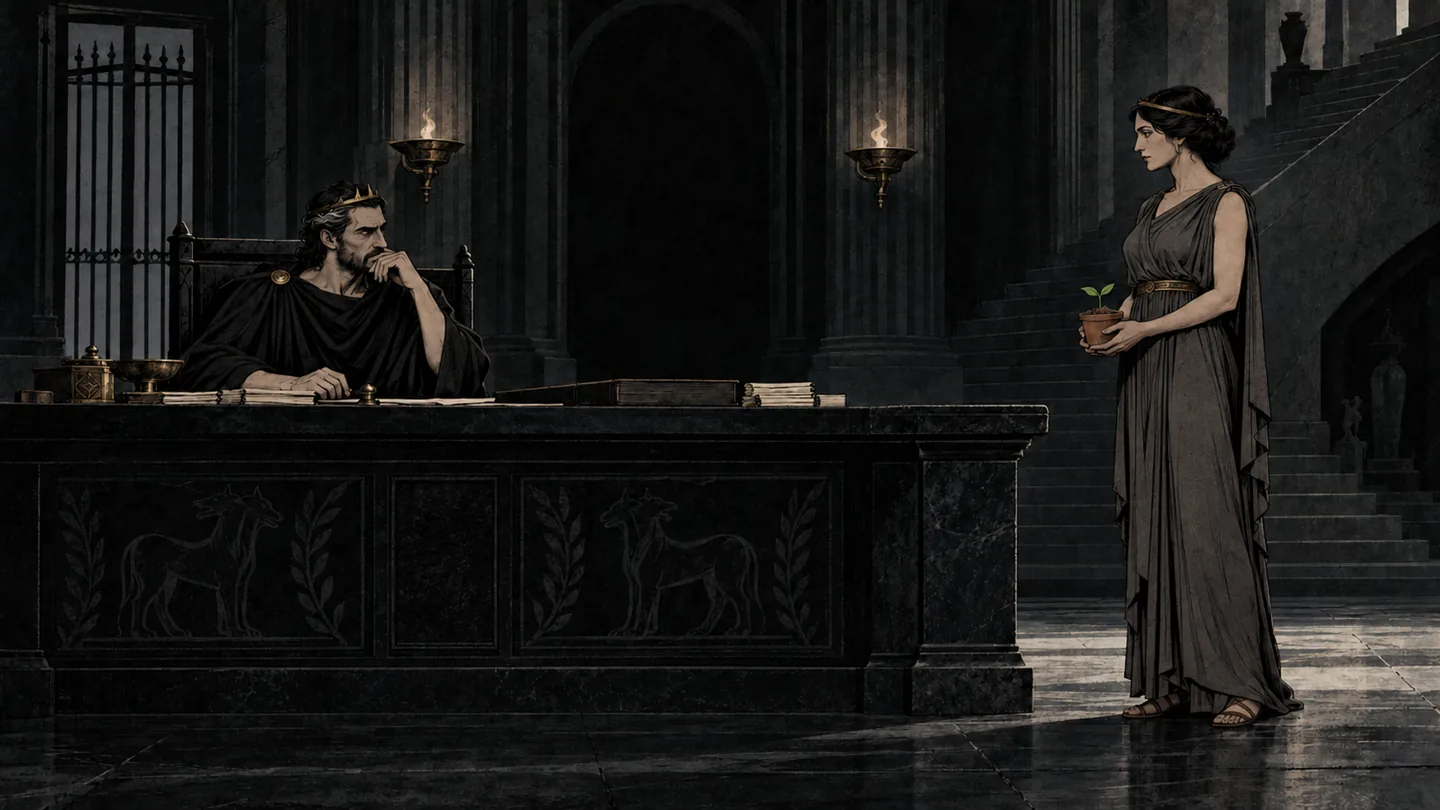
Brief Shapes film artwork: an artistic interpretation, not an archaeological reconstruction.
Sources & further reading
Ancient accounts and the original situation created for this musical are distinguished below. This introduction follows selected surviving sources; it is not an exhaustive catalogue of every tradition.
- Anonymous · Homeric Hymn 2 to Demeter1–32; 305–333; 360–403; 441–482 · translated by H. G. Evelyn-White. Read the source ›
Abduction, famine, the pomegranate and the one-third/two-thirds arrangement. - Ovid · Metamorphoses5.341–571, especially 564–571 · translated by Brookes More. Read the source ›
The Roman telling and its equal division of the year.
Beyond our artwork
The Met’s Attic red-figure bell-krater attributed to the Persephone Painter, ca. 440 BCE (28.57.23), shows Persephone’s ascent with Hermes, Hekate and Demeter. This ancient return scene is distinct from our invented garden. Its museum summary uses the half-year version, not the fraction in the Homeric Hymn.
Persephone returns to the upper world ›
External museum record; its image remains on the institution’s website. No reproduction rights are implied.