 Brief Shapes
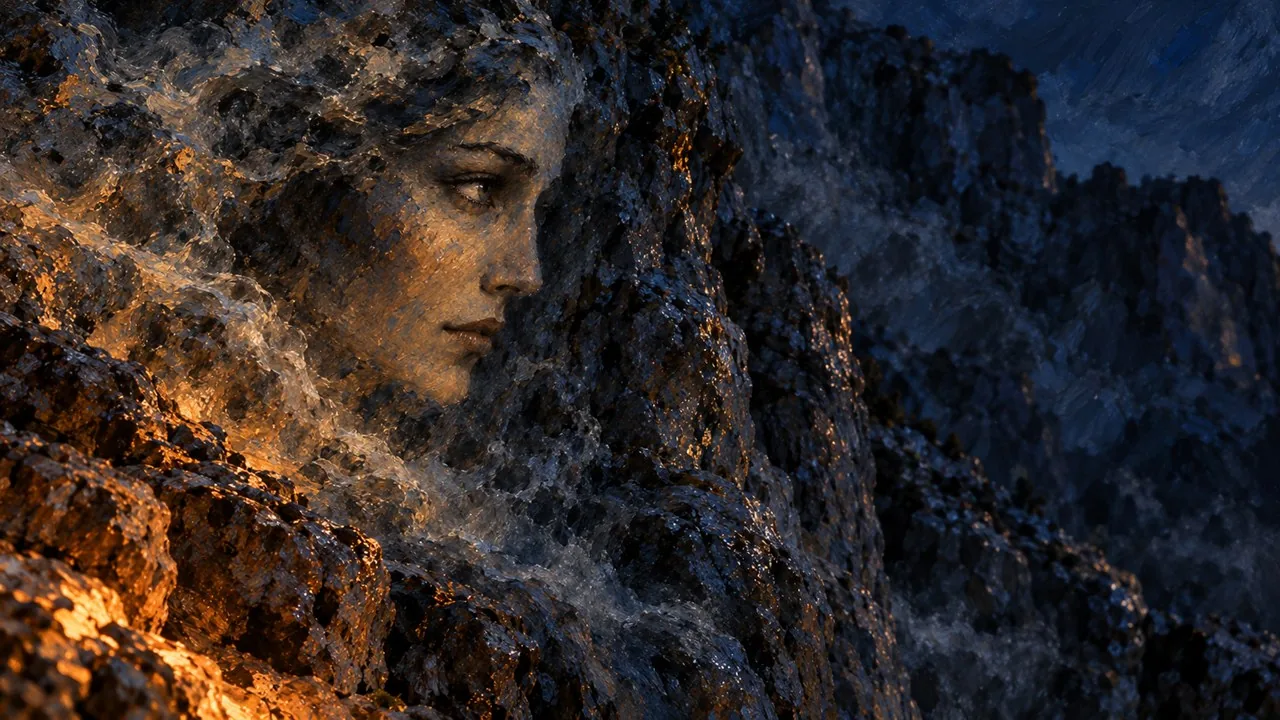
A weary traveller shelters among wet stones. An answer comes back from the valley, and he assumes the landscape is mocking him. Our Echo begins after the familiar tragedy, with a person still present inside the words other people mistake for a sound effect. The encounter asks for no miracle of restoration. It asks whether listening can change when the listener stops believing that his own voice is the only one that matters.
A voice that remains
In Ovid’s Metamorphoses, Echo once has both a body and abundant speech. She distracts Juno with conversation while Jupiter’s companions escape. Juno punishes her by restricting her speech to the ends of other people’s utterances. When Echo falls in love with Narcissus, she must wait for words she can return. Repetition becomes both a constraint and a way to express desire.
Narcissus rejects her embrace. Echo withdraws and wastes away until only voice and bones remain; her bones become stone. Later she answers his suffering and farewell even though he has hurt her. Ovid’s story joins a physical explanation for the echo to a painful encounter in which the words heard do not secure the recognition desired. Our invented traveller does not occur in that poem.
Sources: Ovid.
Music survives another kind of violence
Longus tells a separate origin in Daphnis and Chloe III.23. His Echo is the mortal daughter of a nymph, educated in music by the Muses. She refuses men and gods. Pan, angered by her refusal and jealous of her ability, drives shepherds to kill and dismember her. Earth conceals her remains while her gift of imitation survives, sounding back even Pan’s own music.
This is not an episode to insert before or after Ovid’s Narcissus story. It gives the enduring voice a different history. Our film takes the bodiless Echo associated with the Narcissus tradition as its starting point, while leaving this alternative visible rather than presenting a single “official” biography.
Sources: Longus.
Not a cure. An encounter.
The traveller and the conversation are our invention. At first he treats Echo as a trick of the rocks. Then he begins to hear intention. Her short answers can tease, refuse or invite. The same returned words can mean something different in her mouth, and that difference is the centre of the musical rather than an obstacle to be removed.
We make her agency audible through selection. The written exchanges preserve replies drawn from the endings of the preceding male passages. Within that restriction she does not simply agree with whatever he says. When he begins deciding what she must feel, she corrects him. His task is not to decode her once and announce that he has solved the puzzle. It is to allow her next answer to surprise him.
That also changes the role of his kindness. He cannot rescue her by declaring what she needs. He becomes useful company when he stops filling the space with explanations. His rueful acceptance is gentler than a grand romantic promise, but it requires a genuine change: recognising that listening does not entitle him to ownership of the reply.
The film is tender and faintly flirtatious without turning desire into a magical remedy. Echo remains bodiless. The landscape does not release a restored woman as a reward for the traveller’s sensitivity, and her invitation is not proof that an ancient curse has ended. We wanted the affection to matter in the conditions that actually exist.
At the end he has a road he can take. Instead of presuming he should remain, he asks. She chooses company. That modest exchange is our imagined ending: two presences sharing time, with neither required to become somebody else first. It is hopeful precisely because it does not erase the loss that came before it.
A face in the dusk
The paintings give Echo an expressive presence in rock and mist without restoring a separate body. Blue dusk and wet stone meet the amber warmth of a small fire. Her image can seem almost to gather out of the surface, inviting a second look rather than making a spectacular entrance.
This is an animatic by design: held illustrations, intimate close-ups, editorial camera drifts and overlapping dissolves. The camera supplies movement while the figures keep the stillness of painted thought. The valley remains available to both characters; there is no supernatural doorway trapping the traveller. The doorway of the song is the room a sentence can leave for another person to answer.
Echo: An Imagined Encounter · A Doorway in the Dark
A few brief shapes.
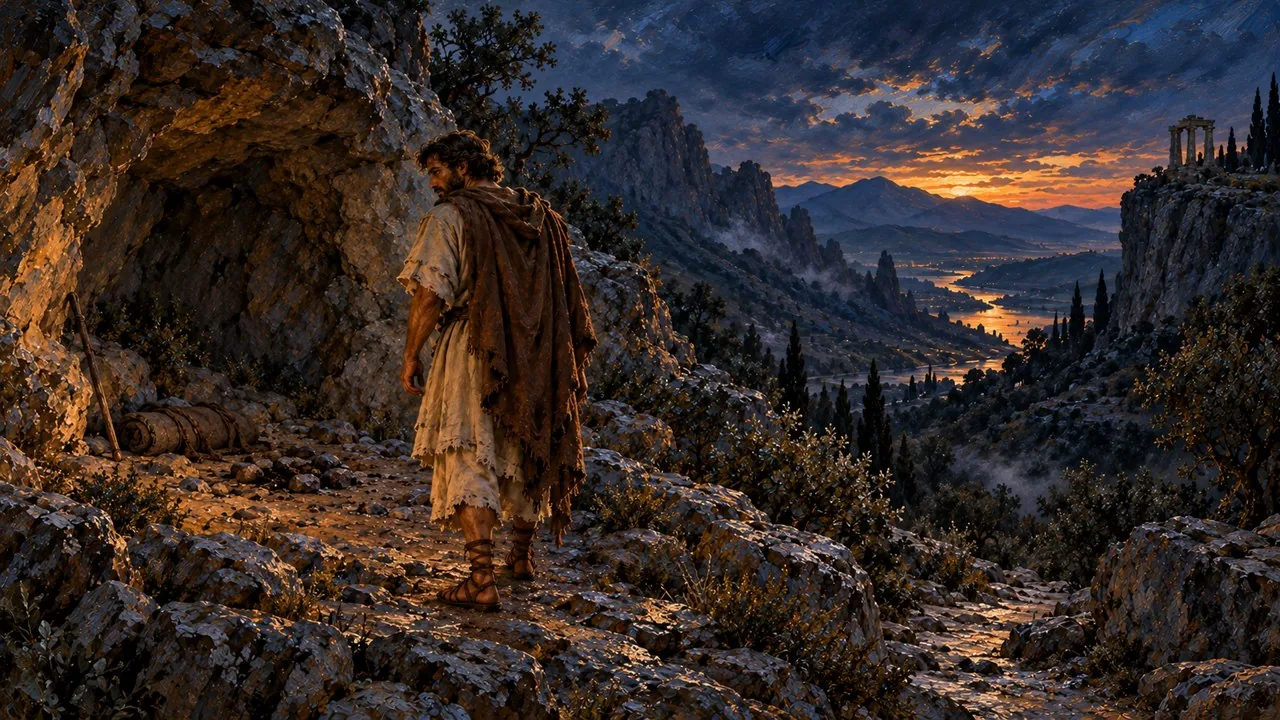
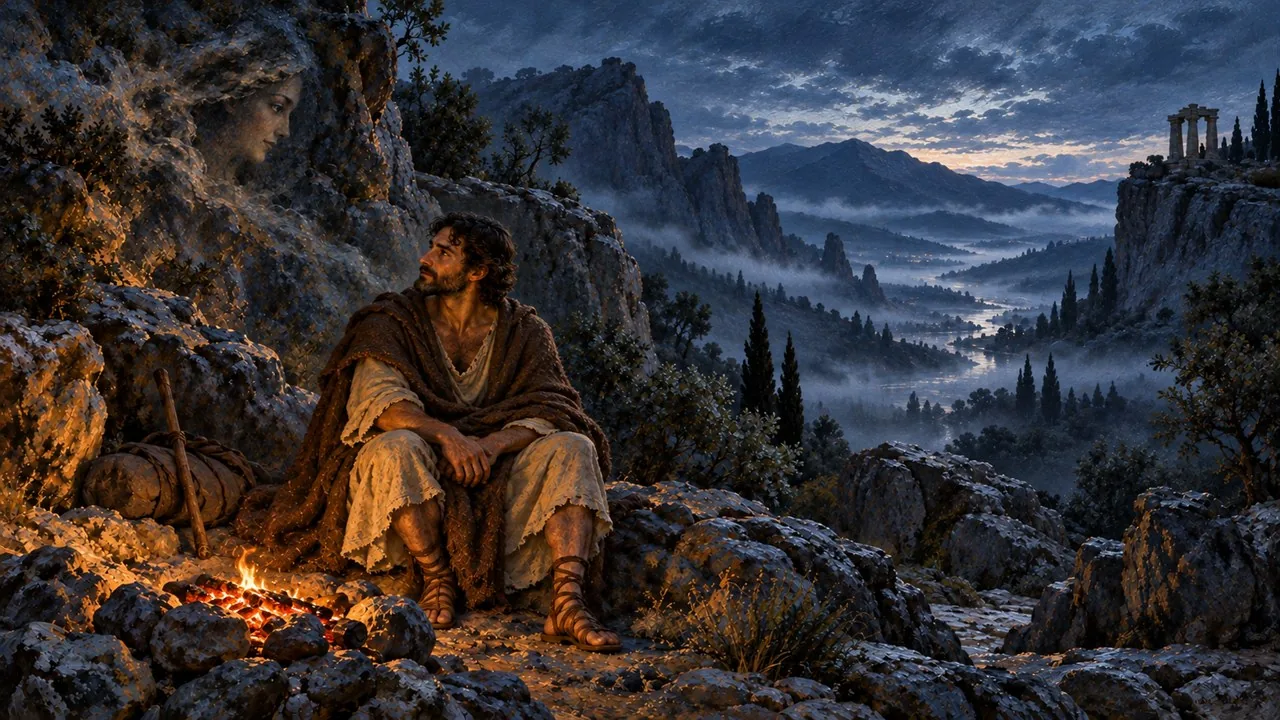
Brief Shapes film artwork: an artistic interpretation, not an archaeological reconstruction.
Sources & further reading
An introduction to the cited ancient accounts and the distinct choices of our film, not an exhaustive catalogue of every surviving tradition.
- Ovid · MetamorphosesIII.359–401 and 494–510 · translated by Brookes More. Read the source ›
Juno’s restriction, the encounter with Narcissus, the wasting of the body and Echo’s continuing voice. - Longus · Daphnis and ChloeIII.23 (within Book III) · translated by Rowland Smith. Read the source ›
The separate Pan and Echo story in The Greek Romances. Search within Book III for the tale of Echo; this volume also contains other novels.