 Brief Shapes
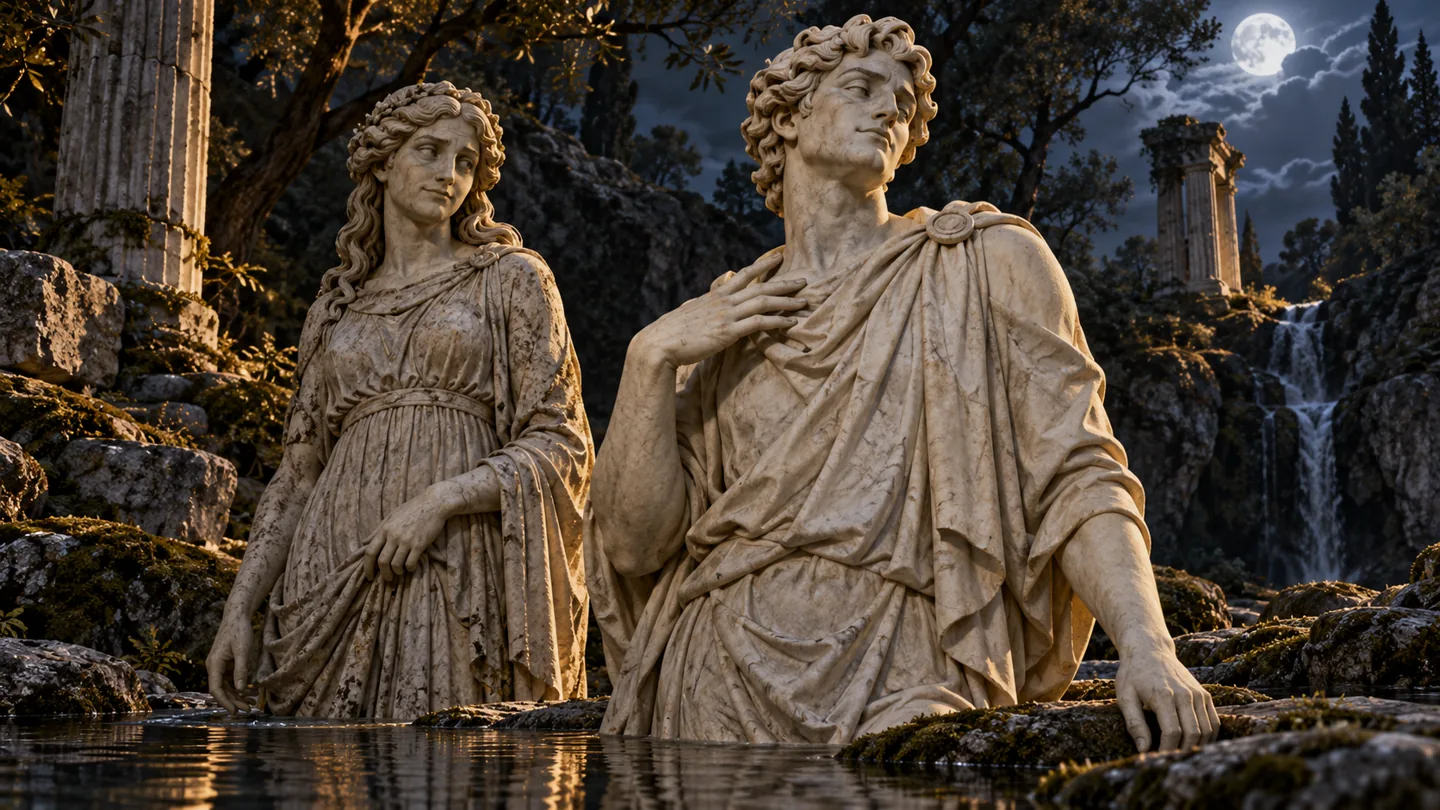
Narcissus is looking for someone who meets his standards. Fortunately, the pool has an excellent candidate. Echo is nearby, offering something less convenient and more alive: another perspective. Someone Like Me turns their failure to meet into a heavy-metal musical performed through monumental stone figures. It keeps the pattern of impossible communication but changes the consequences, leaving its magnificent fool alive to continue admiring the evidence.
Two forms of unreturned desire
Ovid’s Metamorphoses introduces Narcissus as the son of Liriope and the river Cephisus. Tiresias predicts that he will live long if he does not know himself. Echo, already punished by Juno with speech limited to repeating others’ endings, falls in love with him. He rejects her, and she wastes away until her voice survives without her body.
After another rejected admirer calls for Narcissus to suffer unreturned love, he becomes captivated by his reflection. He eventually understands that the beautiful figure is himself, but recognition does not release him. He dies; a flower is found where his body should have been. Echo repeats his grief and farewell. The pool and the returning voice make two different images of desire that cannot reach its object.
Sources: Ovid.
The reflection as a memorial
Pausanias records a spring associated with Narcissus in Boeotia, then challenges the idea that a grown person could fail to recognise a reflection. He reports another, less popular account: Narcissus had a twin sister whom he loved. After her death, he knowingly looked at his own image because its resemblance to her offered consolation.
This changes the emotional centre from mistaken identity to bereavement. Pausanias also argues that the narcissus flower predates the young man, citing a poem in which Persephone gathers it. His discussion does not complete Ovid’s story or supply a missing episode for Echo. It preserves a different explanation alongside explicit scepticism about the familiar one. Our film uses neither the dead twin nor this consolatory interpretation.
Sources: Pausanias.
The perfect listener never disagrees
Our adaptation is deliberately nonfatal. Narcissus does not die and turn into a flower. The comedy follows his confidence into a prolonged negotiation with water, while Echo’s attempts to be heard keep revealing the limitation of his ideal companion. A reflection can match every gesture; it cannot offer the independent response that a relationship requires.
The musical title is therefore a trap laid in plain sight. Someone like him can mean a person with shared interests, or someone whose only acceptable difference is no difference at all. The pool accommodates the second wish perfectly. Echo cannot compete by becoming a more obedient copy, because the important thing about her is the person inside the repetition.
The sequence lets Narcissus inspect, admire and attempt to approach his watery counterpart. Touch spoils the image. An attempted kiss produces a wet philosopher rather than a tragic corpse. His explanations keep pace with his disappointment: the joke is the labour required to protect a flattering theory from the world.
But the film also makes room for a small honest moment and almost-understanding. Those pauses prevent Echo from being merely an accessory to his vanity. She has expectations and reactions of her own. The final repeated description, “Terribly vain”, gives repetition a pointed comic function: borrowed words can still contain judgement. We leave the lesson unresolved rather than pretending that one awkward encounter has permanently cured self-absorption.
This version and the separate Brief Shapes Echo film ask different questions. Here, her presence exposes a failure of attention within a comic duet. In An Imagined Encounter, an original traveller begins to listen differently. Neither film should be mistaken for the missing happy ending of Ovid’s poem; both announce their freedom to imagine another encounter with its characters.
Heavy metal, weathered marble
The visual contrast is central: a forceful metal song meets carved figures, old stone and moonlit ruins. Narcissus poses as if he were already his own monument. Echo stands within the same world but outside the centre of his attention. Moss, water and subdued light interrupt the apparent permanence of the sculpture.
This is an animatic, using held illustrations and restrained camera movement rather than continuous character animation. Close portraits, a low-angle pose and a wider reveal establish the imbalance quickly. The water supplies an unstable second stage beneath the solemn stone. A figure can look immortal while remaining absurdly vulnerable to a ripple, and an image that initially reads as grandeur can become the setting for a very small failure to listen.
Echo & Narcissus: Someone Like Me
A few brief shapes.
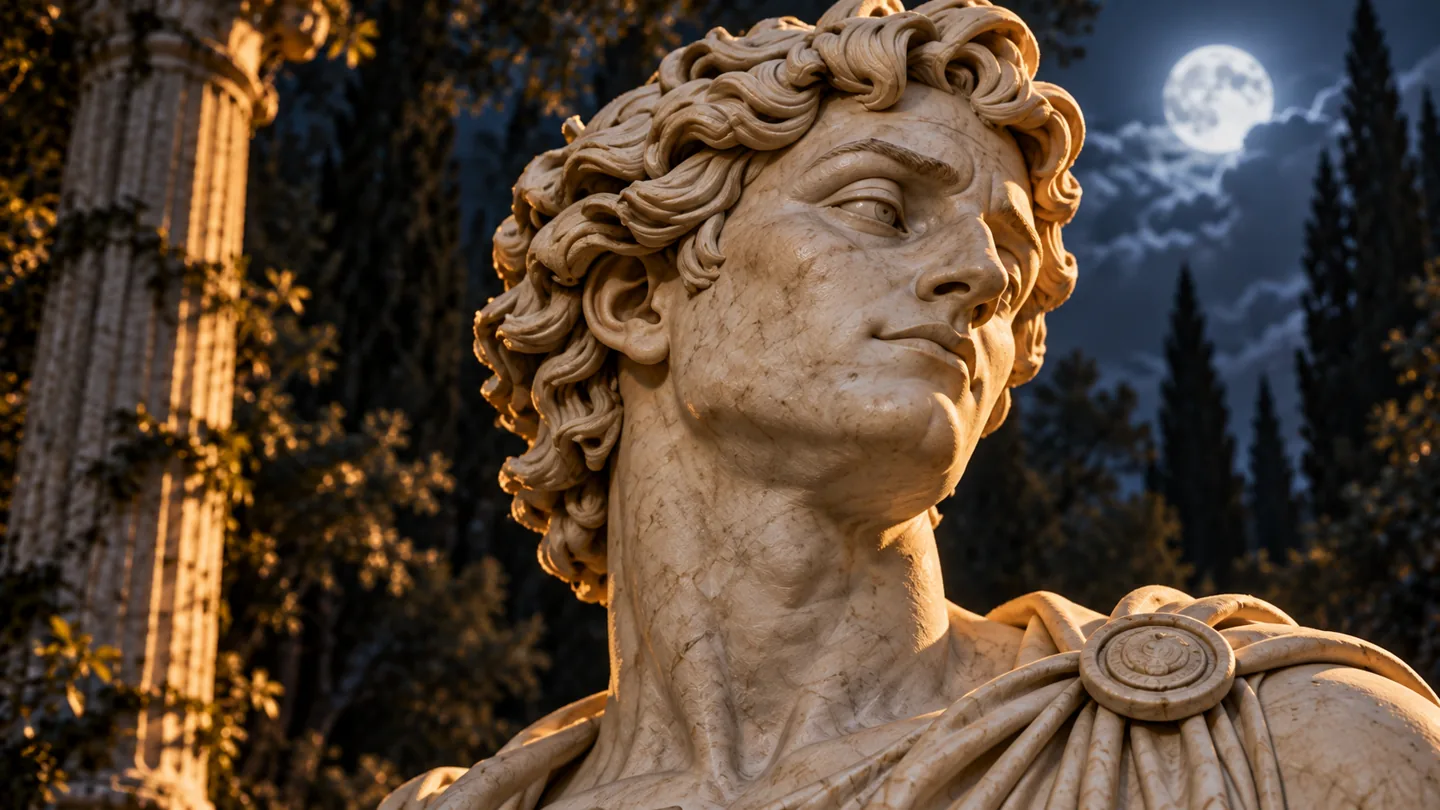
Brief Shapes film artwork: an artistic interpretation, not an archaeological reconstruction.
Sources & further reading
A guide to the ancient accounts relevant to this film, not a claim that Greek mythology has one official version.
- Ovid · MetamorphosesIII.339–510 · translated by A. S. Kline. Read the source ›
The linked translation contains the full Echo and Narcissus episode; our account is an original paraphrase. - Pausanias · Description of GreeceIX.31.7–9 · translated by W. H. S. Jones. Read the source ›
The spring, the alternative twin-sister account, and the objection to the flower’s origin story.