 Brief Shapes
A richly dressed stranger appears on the shore. To the pirates, that is enough information: good clothes, valuable family, profitable voyage. They do not need his name before making a claim on him. Our Dionysus lets the mistake unfold. By the time the ship begins to reveal what they have taken aboard, even the ropes have understood more than the captain.
A warning that goes unheard
Homeric Hymn 7 tells of Tyrsenian pirates seizing a beautiful young stranger in a purple robe. His bonds fall away. The helmsman recognizes that the captive must be a god and urges his release, but the captain dismisses the warning. Wine runs through the ship; vines and ivy transform its rigging. Dionysus becomes a lion and also manifests a bear.
The lion attacks the captain. The other sailors leap into the sea and become dolphins. Dionysus spares the helmsman and reveals his identity. The hymn joins overwhelming punishment to a precise exception: the person who recognized the danger and protested is not treated like the others. This short episode supplies the main sequence of our musical, rather than merely its god’s name.
Sources: Anonymous.
A witness with a name
In Ovid’s Metamorphoses III.582–691, a related voyage is narrated by Acoetes in the larger story of Pentheus resisting Bacchus. Acoetes identifies the captive’s divinity and opposes his companions; the god requests passage to Naxos, and the sailors try to deceive him. Their transformation becomes testimony offered to another man refusing to recognize the god.
Our film follows the hymn rather than importing that frame. Its helmsman is not identified as Acoetes, and Naxos is not made the destination. These are connected ancient tellings with different narrative arrangements. Keeping the distinction avoids giving the short hymn details it does not contain.
Sources: Ovid.
The richest cargo they could have found
We place the song in Dionysus’s own voice. That is a dramatic choice, not the narrative voice of the hymn. It lets the warning sound intimate before it becomes terrifying. He understands the situation long before the crew does, and his composure makes their certainty increasingly absurd.
The chorus turns the kidnapping into a repeated miscalculation. The pirates think captivity is something they impose; the song reverses that assumption as the ship itself becomes an extension of the person they mean to sell. They have brought abundance aboard, but it is an abundance that refuses to remain merchandise.
Wine and vegetation do more than decorate the punishment. They answer the captain’s desire for wealth with an excessive, uncontrollable version of richness. A profitable hold is useful only while somebody can command it. Grapes across a sail and wine underfoot make possession look like a less stable arrangement than he supposed.
The film omits the hymn’s bear apparition so the climax can concentrate on the lion. It also leaves the captain’s ultimate fate unstated. The menace is not an invitation to supply graphic violence in the gaps. The wine-red water is a colour motif, not blood. These choices are part of our adaptation, not corrections to the ancient text.
The helmsman’s mercy prevents the ending from becoming an indiscriminate spectacle of power. He paid attention when attention was unpopular. Dionysus can distinguish him from the group. The moment of recognition is therefore as important as the spectacular transformations: somebody understood that this was not a thing to own, and said so.
A sea that looks painted into stone
The dark maritime-fresco design gives the voyage a weathered, patterned surface. In the production concept artwork, Dionysus stands almost casually against the mast while the sailors look toward him and the sea burns wine-red beneath a gold sky. The scene suggests an old painted story coming alive, without claiming to reproduce a particular ancient fresco.
The humour depends on keeping him magnificent rather than reducing him to a prankster. The crew’s greed creates the absurdity; the god does not need comic incompetence to answer it. A warning can be memorable and musical while still meaning exactly what it says. That balance lets the film travel from sly confidence to genuine danger without changing the central character.
Wrong God to Kidnap
One brief shape.
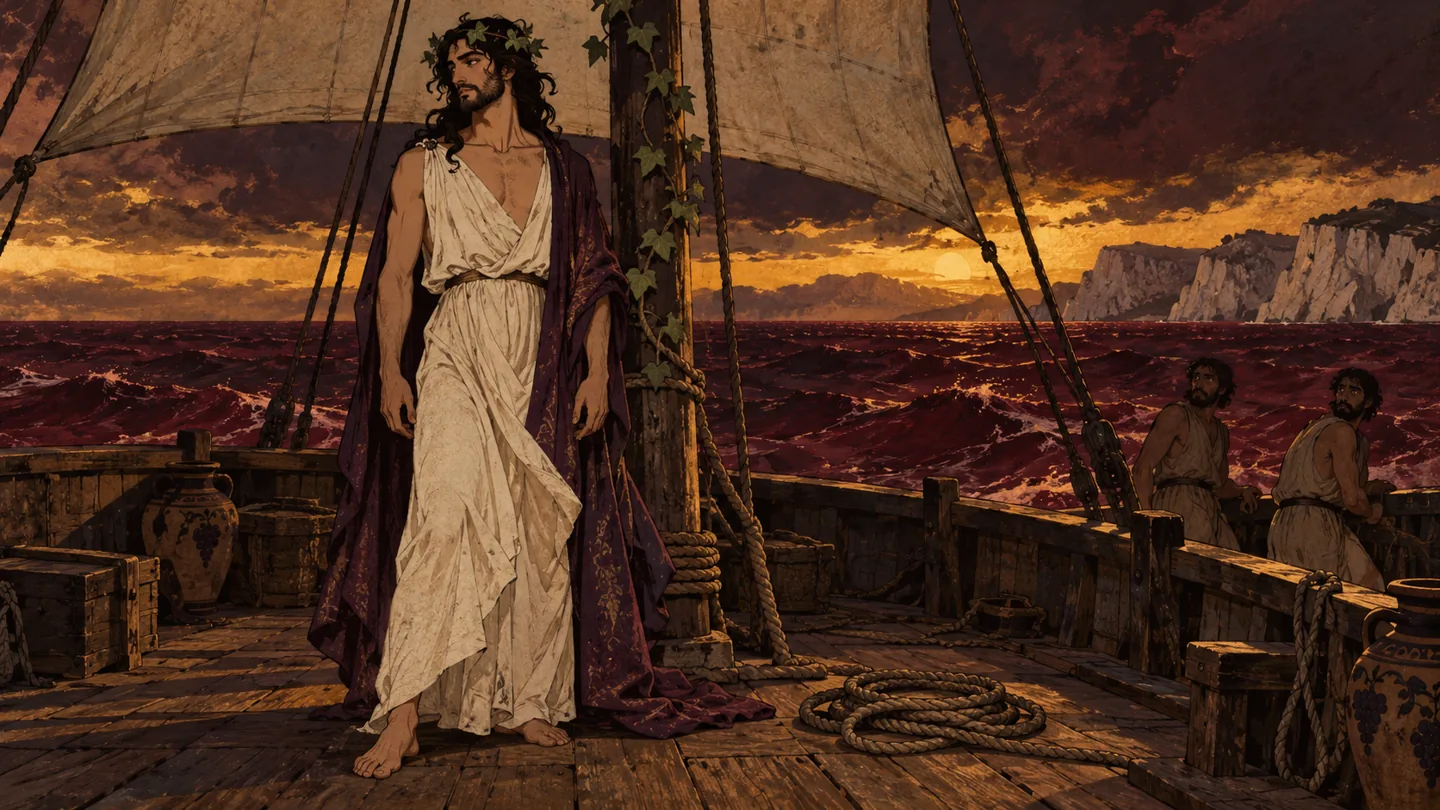
Brief Shapes film artwork: an artistic interpretation, not an archaeological reconstruction.
Sources & further reading
Ancient accounts and the original situation created for this musical are distinguished below. This introduction follows selected surviving sources; it is not an exhaustive catalogue of every tradition.
- Anonymous · Homeric Hymn 7 to Dionysus1–59 · translated by H. G. Evelyn-White. Read the source ›
The pirate capture, miracles aboard ship, transformation and mercy to the helmsman. - Ovid · Metamorphoses3.582–691 · translated by Brookes More. Read the source ›
Acoetes’s related account within the story of Pentheus; not the film’s narrative frame.
Beyond our artwork
Getty’s Attic Black-Figure Zone Cup includes Dionysos holding a kantharos and a vine. Its ancient imagery offers another way to look at the god’s attributes; it is not a storyboard for this film.
Dionysos with a vine and drinking cup ›
External museum record; its image remains on the institution’s website. No reproduction rights are implied.