 Brief Shapes
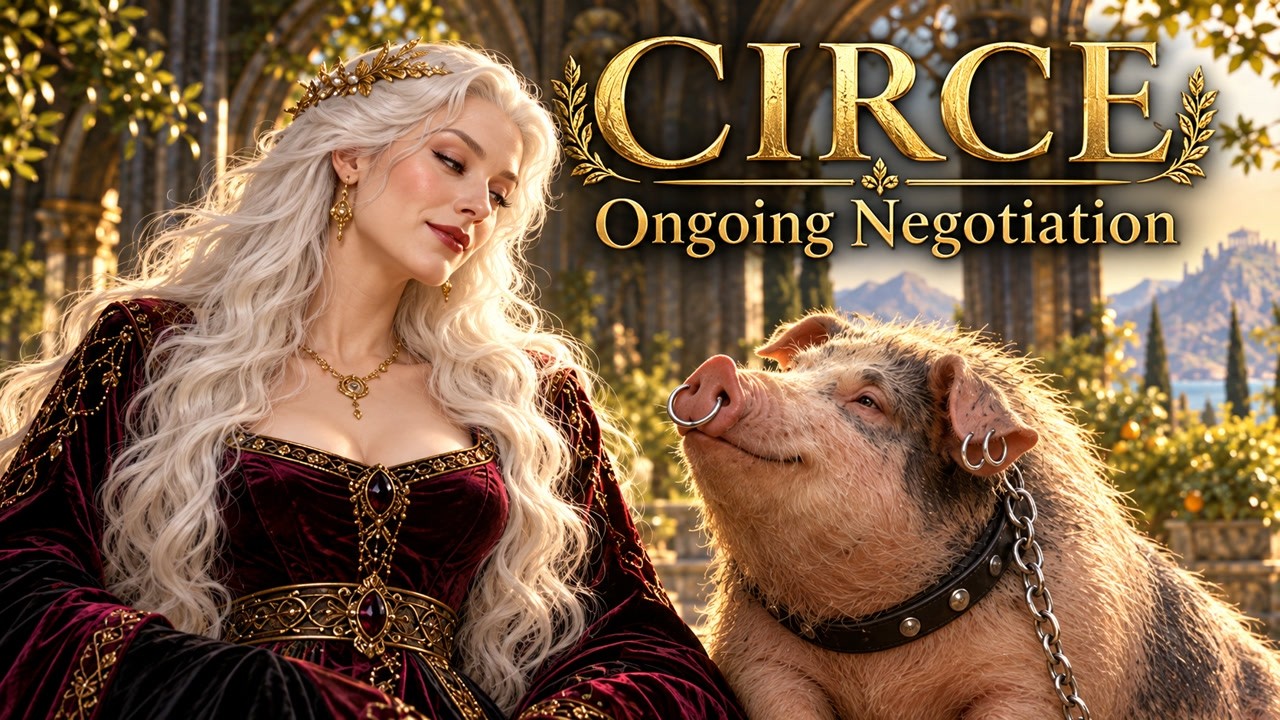
A goddess can change a body. A pig can still have an opinion. Circe and Gryllus meet in our second Season Three film with rather different ideas about a good life, and enough confidence to enjoy the disagreement. Ongoing Negotiation makes a soul-funk duet out of power, contentment and the awkward possibility that someone else may already be happy.
The men inside the pigs
In Book 10 of Homer’s Odyssey, Circe lives on Aeaea. She is a divine daughter of Helios, singing at her loom when Odysseus’s companions approach. She gives the visitors a drugged drink and changes them into pigs with her wand. Their minds remain human, and they weep. Eurylochus, who stayed outside, escapes to tell Odysseus.
Hermes supplies the protective herb moly. Odysseus withstands Circe’s magic, confronts her and obtains an oath. She eventually restores his companions to human form. The same episode moves from danger to hospitality: Circe becomes a host and an important guide for the journey ahead.
Homer does not give us a named, contented Gryllus debating the merits of remaining a pig. The men’s distress matters. Our cheerful duet belongs to a different imaginative branch of the story.
Source: Homer, Odyssey 10.
The pig who declines the rescue
Centuries later, Plutarch turns the transformation into a philosophical comedy. His dialogue Gryllus, also known as Beasts Are Rational, begins with Odysseus asking Circe to restore other Greeks living as animals. She tells him to ask whether they want to return. She gives one of them speech and leaves him to argue freely with the hero.
That speaker is Gryllus. He prefers his present life and challenges the assumption that humans are superior. His arguments range across courage, moderation and intelligence. In one especially earthy comparison, former admiration for costly possessions gives way to sleeping comfortably in mud.
The main debate is between Gryllus and Odysseus, not a duet between Gryllus and Circe. It is a later literary response to Homer, not a missing scene from the epic. Its sweeping claims about animals are arguments within a provocative dialogue, rather than modern zoology.
Source: Plutarch, Gryllus.
Two kinds of freedom, one conversation
We keep the delightful inconvenience of a pig who does not consider himself a problem. Then we change the conversation. Circe takes the other vocal part, and Odysseus leaves the stage. This pairing, the song and its negotiation are our inventions.
Circe is powerful, self-possessed and quite capable of holding the room. Gryllus is contented, opinionated and equally capable of holding his ground. Their equality is dramatic rather than magical: she has extraordinary powers, but neither voice is treated as disposable. The humour comes from two strong positions having to share the same morning.
Gryllus’s satisfaction creates a useful difficulty. If he likes the life he has, offering him a different one does not settle the matter. Freedom includes being able to describe what suits you, even when that answer seems unambitious or ridiculous to somebody else. A pig’s pleasure need not be a failure to understand a goddess’s invitation.
Circe, meanwhile, is more than the obstacle from which a hero must escape. We give her a point of view, wit and presence of her own. Letting Gryllus answer back does not make her smaller. A conversation can be lively without requiring either participant to become its loser.
This is a deliberate change of tone. It does not make Homer’s involuntary transformation harmless, or claim that his frightened companions secretly wanted it. Nor does our respectful duet reproduce every attitude in Plutarch’s much sharper argument. We take an ancient question about the good life and stage a new encounter around it.
The title leaves room for that encounter to continue. An ongoing negotiation need not be a broken relationship waiting for one decisive victory. Here it is a way for two distinct people—or a goddess and a very assured pig—to keep listening without first agreeing to become alike.
Gothic authority meets heavy-metal ease
Our ultra-pale Circe brings Gothic grandeur to the exchange. Gryllus answers with the unmistakable attitude of a heavy-metal pig. These are contemporary character designs, not reconstructions of ancient dress or claims about how either author imagined the figures.
The soul-funk duet gives their differences a shared pulse. Grandeur and earthy satisfaction can occupy the same musical space; humour need not cancel dignity. The visual contrast makes the meeting immediately readable, while the exchange itself asks us to give both speakers a hearing.
Circe: Ongoing Negotiation
Sources & further reading
Two distinct ancient works, followed by our own adaptation. Neither source contains the duet performed in the film.
- Homer · OdysseyBook 10, especially 133–399 and 467–574 · translated by A. T. Murray. Read the source ›
Circe’s island, transformation, Hermes’s assistance, the men’s restoration and the preparations to continue the journey. - Plutarch · Gryllus (Beasts Are Rational)Moralia 985D–992E, especially sections 1–2 and 6 · English translations edited by William Watson Goodwin, 1878. Read the source ›
Circe introduces the question of willingness; Gryllus and Odysseus debate animal and human life. This older translation calls Odysseus Ulysses and titles the work That Brute Beasts Make Use of Reason.