 Brief Shapes
What if the guardian at the edge of the Underworld had a working day? Three Heads, One Good Boy begins with a familiar monster and moves the attention away from the hero who might defeat him. Cerberus has responsibilities, several competing opinions and someone in front of him who is already frightened enough. Our story is invented; the gate he guards has a much older history.
A gate that opens only one way
Hesiod’s Theogony makes Cerberus a child of Typhaon and Echidna, and describes him as fifty-headed. Later in the poem, the hound before the house of Hades and Persephone welcomes arrivals but prevents departure, devouring those who try to leave. The apparently friendly greeting is a dangerous trick, not evidence that Hesiod wrote a secretly gentle pet.
Three heads are familiar, but they are not the only ancient number. Keeping that distinction visible lets us enjoy the film’s three-part comedy without treating one modern silhouette as a universal specification.
Sources: Hesiod.
The labour in which he comes back
In Apollodorus’s Library II.5.12, Heracles must bring Cerberus from Hades. This dog has three canine heads, a dragon-like tail and snakes on his back. The ruler of the Underworld permits the capture if Heracles uses no weapons. Heracles subdues the animal, takes him to Eurystheus and returns him to Hades. The labour is a capture, not the killing of Cerberus.
An ancient vase linked below offers another visual variation: the Artizon Museum describes its Cerberus as two-headed. Literary and painted traditions do not always agree about anatomy. The differences are worth looking at rather than correcting away.
Sources: Apollodorus, Artizon Museum.
The person at the gate
The published film describes an original fictional working day. Its frightened newcomer, internal squabbling and lesson about kindness are our comic invention, not a retelling of a particular ancient encounter. Heracles’s capture is useful background to the character, but it is not the plot of this musical. No source cited here contains our dialogue or its particular visitor.
Giving three heads three different ideas turns a monstrous feature into a character relationship. The disagreement is inside one guardian, so the task of deciding how to respond becomes visibly complicated. A large body and a terrifying reputation do not automatically produce a clear answer. The comic possibility lies in the distance between looking fearsome and knowing what the moment needs.
The newcomer changes the question. Instead of asking whether Cerberus is strong enough to enforce a rule, the story asks whether a guardian can recognise fear without adding to it. Kindness becomes part of the job rather than its opposite. That is a contemporary interpretation of the encounter, not a historical claim about ancient beliefs concerning the afterlife.
We do not need to erase the monster in order to make room for tenderness. His intimidating shape establishes what an arrival might expect. The response then has somewhere to travel. If the viewer already knows Cerberus as a hero’s obstacle, it is especially useful to stay at the gate with him for once and watch the other person arrive.
Three expressions in one frame
The film’s painted-animatic presentation allows the faces to do a great deal of the work. In the promotional image, the heads already disagree in their expressions: alert suspicion, stubborn severity and a softer, uncertain look share one collar. The image offers the comic premise before the musical explains it.
The warm, dramatic Underworld setting keeps the encounter from becoming an ordinary domestic dog scene. That tension is important to the tone: a formidable mythic guardian can still behave in ways we recognise. The artwork is our own theatrical world, not a reconstruction of a Greek sanctuary, an ancient image or a claim about what the dead would literally see.
Goodness is an action
Calling him a good boy is a joke, but it also puts a small ethical question beneath the spectacle. Is doing a job well only a matter of appearing sufficiently severe? Or can attention to a vulnerable arrival be part of doing it properly? The musical answers through a fictional encounter rather than a speech about rules.
Brief Shapes often gives an enormous figure a brief human-scale moment. Here the scale is three heads and the threshold of death; the moment is a choice about how to receive someone. Nothing requires us to mistake that gentler fiction for Hesiod. The old guard dog and our imagined working guardian can stand beside one another, with the difference plainly acknowledged.
Cerberus: Three Heads, One Good Boy
One brief shape.
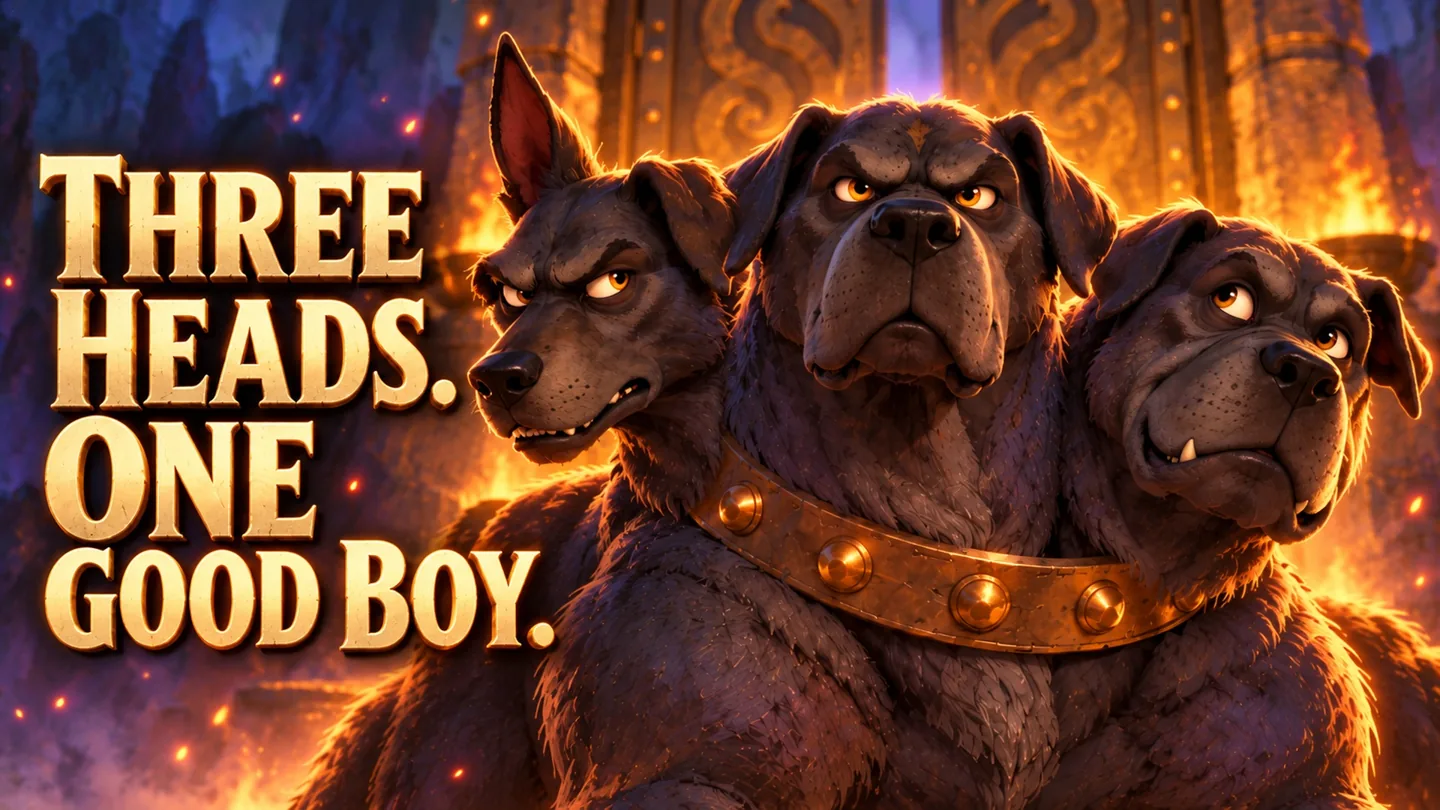
Brief Shapes film artwork: an artistic interpretation, not an archaeological reconstruction.
Sources & further reading
An introduction to the cited ancient traditions, distinguished from the original lyrics, comic situations and visual choices of our film. Not an exhaustive record of every ancient reference.
- Hesiod · TheogonyLines 306–312 and767–774 · translated by H. G. Evelyn-White. Read the source ›
Parentage, fifty heads and the hound’s one-way guardianship. - Apollodorus · LibraryII.5.12 · translated by J. G. Frazer. Read the source ›
Heracles captures and returns a three-headed Cerberus. - Artizon Museum · Attic Black-Figure Neck-Amphora, Herakles and KerberosPainter of Boulogne441, about520–510BCE. Read the source ›
The catalogue describes a two-headed dog: an example of ancient visual variation.
Beyond our artwork
Artizon Museum. Painter of Boulogne441, about520–510BCE. The catalogue identifies a two-headed Cerberus in the capture scene. External museum link only; no image copied.
Herakles and Kerberos on an Attic amphora ›
External museum record; its image remains on the institution’s website. No reproduction rights are implied.