 Brief Shapes
A gift can announce the greatness of its giver, or make life better for the people receiving it. Our Athena musical lets that difference unfold between two divine entrances. It begins as a competition over a city and becomes a question about belonging. What does a god offer when the aim is not merely to astonish, but to help people live together?
An olive and a sea
In the Library attributed to Apollodorus, Athena and Poseidon contend for Attica during the reign of Cecrops. Poseidon strikes the Acropolis with his trident and produces a sea. Athena plants an olive tree and calls Cecrops as her witness. Zeus separates the rivals and appoints the twelve gods to judge. Athena receives the country, and the city takes her name. Poseidon answers his defeat by flooding the Thriasian plain.
The account explicitly distinguishes its divine judges from other traditions naming human arbiters. It does not describe a public vote on which gift is more useful. The practical comparison in our song is an adaptation of the two gifts, not a transcript of the ancient judging process.
Sources: Pseudo-Apollodorus.
A tree that grows again
Herodotus places the olive and the saltwater among the sacred signs on the Acropolis. In his account of the Persian invasion, the tree burns with the sanctuary; Athenians returning to sacrifice report a fresh shoot rising from the stump the following day. He presents the tree and water as witnesses to the gods’ contest, and the new growth as a remarkable report within a story of destruction.
This is not the episode dramatised in our film. It helps show why the olive is more than a convenient prize in a divine competition: it also belongs to the city’s memory of survival. We keep that ancient testimony separate from our imagined vision of harvests, lamps and shared meals.
Sources: Herodotus.
The gift that keeps making room
Our song turns the rivals into contrasting performers. Poseidon arrives with majestic confidence, delighted by the scale of his own entrance. The seawater is a miracle; its saltiness becomes the joke. Athena waits for the splash to settle and answers with an apparently unimpressive plant. The difference in size lets the comedy work before the larger emotional argument comes into view.
Her answer is not another display of force. She imagines the tree’s uses over time: shade in summer, fruit prepared for eating, oil for lamps, and a table where people can gather. Those benefits require seasons and human work. The imagined future is important. This is not a claim that freshly picked olives are immediately ready for supper or that a tree produces a harvest at the instant it is planted.
As the song opens out, the scale changes. The city is no longer an audience waiting to be impressed. It contains people who work, rest, eat and meet strangers. The tree becomes a way of seeing those ordinary needs. Athena’s wisdom is made tangible through hospitality rather than explained as an abstract divine quality.
The sharpest departure arrives at the ending. Instead of repeating the destructive aftermath in our principal source, the musical offers Poseidon a place at the table. He is allowed to wonder how a small gift can make stone feel like home. Athena’s invitation leaves room for reconciliation. That generosity is our invention: the song does not claim that the ancient account ends with the rivals sharing supper.
From the grand entrance to the lantern
The song’s structure supplies a visual rhythm: the force of the arrival, the modest tree, then a widening sense of community. What first appears small gains meaning through the people around it. The emotional movement is not simply from one winner to one loser. It is from competitive display toward the possibility of a shared space.
Our title keeps the emphasis on the small object rather than the victory. Athena does not need to become louder than the sea. She needs the audience to imagine what can happen beneath a branch, beside a lamp, or across a table. The film’s human scale belongs to that invitation, even though its speakers are gods.
More than winning
For Brief Shapes, immortality is often a way of looking closely at something brief. A meal ends; a stranger becomes familiar; daylight gives way to lamplight. None of those moments lasts forever, and that is not a reason to value them less. Here the lasting tree makes room for temporary lives.
The story can still be enjoyed as a contest, with a witty answer to a magnificent boast. But the musical asks what victory might make possible after the applause. Our answer is deliberately gentler than punishment: a seat remains available, even for the person who expected to win.
A Little Olive Tree
One brief shape.
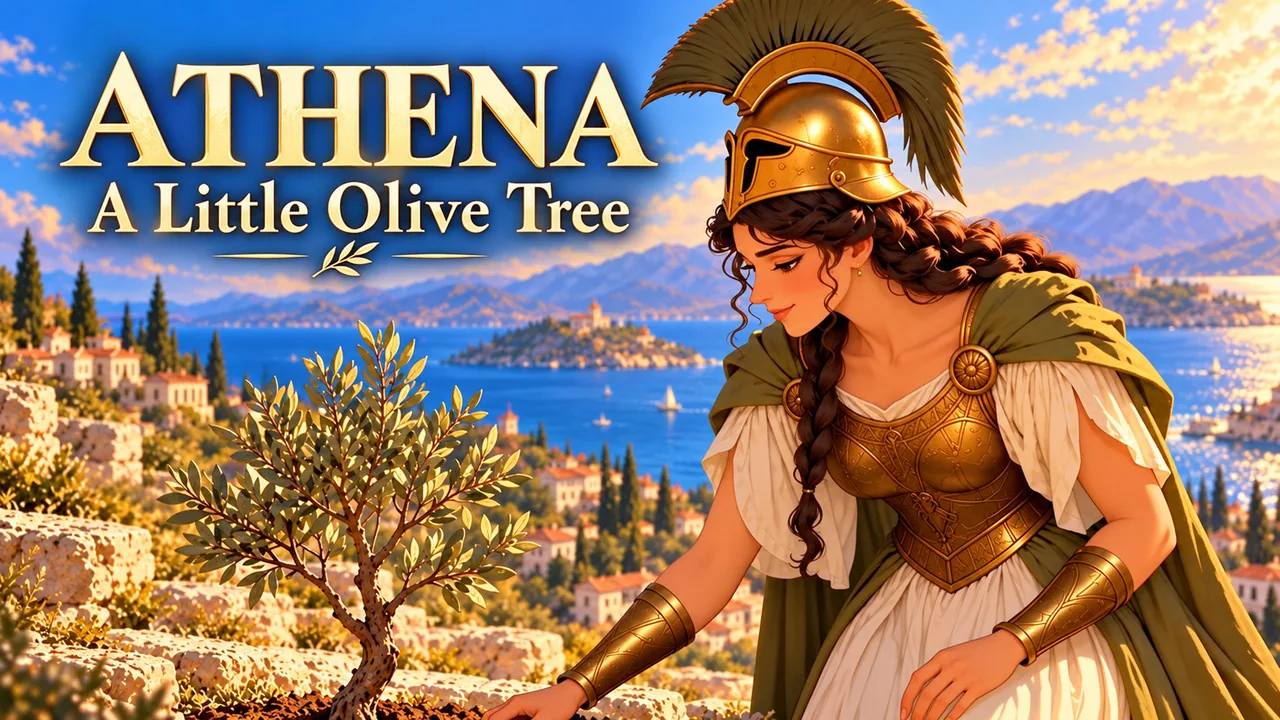
Brief Shapes film artwork: an artistic interpretation, not an archaeological reconstruction.
Sources & further reading
This page focuses on the contest for Athens, not every story associated with Athena. The communal meal and invitation to Poseidon are our alternative ending.
- Pseudo-Apollodorus · Library3.14.1 · translated by J. G. Frazer. Read the source ›
The gifts, Cecrops’s testimony, the twelve divine judges and Poseidon’s flood. - Herodotus · Histories8.55 · translated by G. C. Macaulay. Read the source ›
The sacred olive and saltwater on the Acropolis, and the report of a fresh shoot after the Persian burning.
Beyond our artwork
The museum explains how the Erechtheion accommodated the sacred symbols associated with Athena and Poseidon’s contest. Its illustrated page provides architectural context, not a reconstruction of our musical.
The Erechtheion · Acropolis Museum ›
External museum record; its image remains on the institution’s website. No reproduction rights are implied.