 Brief Shapes
Atalanta is not slow, foolish or easily defeated. That is why this race is worth telling. Our musical lets her narrate at full speed: confident, funny, slightly distracted by an attractive rival, and still fast enough to recover. Then the rules of the contest change beneath her feet. Golden Distraction keeps the wit, but it refuses to pretend the final result is simply a fair victory.
Three apples, not three identical choices
In Ovid’s Metamorphoses X, an oracle warns Atalanta against marriage. She demands that a suitor defeat her in a race; losing means death. Hippomenes asks Venus for help, and receives three golden apples. Atalanta is attracted to him, sometimes slowing to look at his face. She retrieves the first two apples yet regains the lead each time.
The third is different. Hippomenes throws it far to the side. Venus forces the hesitant Atalanta to pursue it and makes it heavier, costing her the race. Ovid continues beyond the marriage: Hippomenes neglects to thank Venus, divine retaliation leads to the couple’s desecration of a sacred place, and they become lions. The film ends before that aftermath.
Sources: Ovid.
The huntress beyond the race
Apollodorus’s Library III.9.2 tells of an infant exposed because her father wanted a boy, nursed by a bear and raised by hunters. Atalanta becomes a formidable huntress. This account names the winning suitor Melanion, while also recording Hippomenes as a different tradition. It associates the couple’s transformation with a precinct of Zeus. Names, parentage and circumstances vary: they should not be silently combined.
Sources: Apollodorus.
Let her tell it
Our song gives every sung word to Atalanta. Hippomenes and Aphrodite act within the story, but they do not take over its telling. The first-person viewpoint makes the contest something experienced rather than simply recorded: confidence, calculation, attraction, irritation and disbelief can all occur between two footfalls.
The first two detours are comic. She finds reasons why leaving miraculous fruit in the dirt would be absurd, then demonstrates that she can afford the delay. Her speed repairs the mistake. Those jokes are not meant to establish a woman who deserves to lose because she likes shiny things. They establish how strong she is before the third intervention removes the possibility of a fair contest.
The quieter bridge matters just as much as the sprint. For a moment, she and her opponent are alongside one another. She can imagine wanting him there. Attraction is not an invented excuse added to make the ending nicer: it is present in Ovid. Our emphasis is that liking someone does not mean consenting to whatever wins them the contest. A possible romance and an unfair method can exist at the same time.
We use the Greek name Aphrodite where Ovid, a Roman poet, names Venus. The comic commentary, rationalisations and closing challenge are newly written. The film omits the execution of defeated suitors and stops at the finish rather than staging the later transformation. That is a chosen boundary, not a claim that the complete ancient story ends happily with a wedding.
Gold against a storm
The production’s storm-and-gold imagery lets the temptation gleam without making the race itself weightless. Atalanta is an athlete in motion, not an ornament being passed from one owner to another. Dust, muscular effort and the pressure of the spectators give the supernatural fruit something physical to interrupt.
The promotional artwork places her in front of the pursuing man, with forward momentum in both bodies. That is the essential arrangement to keep in mind: without interference, she is the person he cannot catch. The gold is not a substitute for her ability. It is what his strategy needs because her ability is real.
A second that cannot be recovered
The song’s repeated promise to win back a lost second eventually fails. It is a small temporal loss with a large consequence, exactly the kind of imbalance that interests Brief Shapes. We can cheer the rhythm and still hear the uncertainty in the result. A crowd announcing a winner does not settle every question about how the finish was reached.
Her final joke keeps her voice intact. It does not announce a rematch preserved in an ancient source, or erase what has happened. It gives her one last moment of judgement. The race is over; her capacity to recognise nonsense is not. That is the difference between telling the story of a prize and allowing the person called a prize to speak.
Atalanta: Golden Distraction
One brief shape.
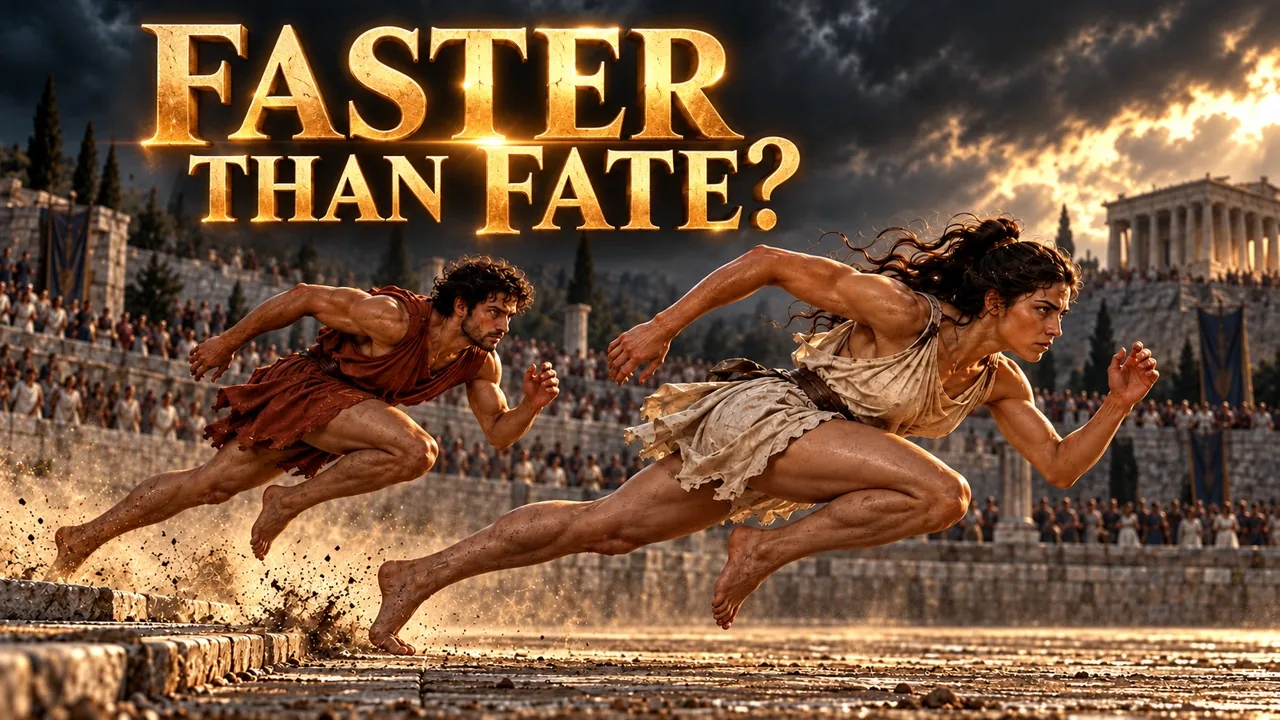
Brief Shapes film artwork: an artistic interpretation, not an archaeological reconstruction.
Sources & further reading
An introduction to the cited ancient traditions, distinguished from the original lyrics, comic situations and visual choices of our film. Not an exhaustive record of every ancient reference.
- Ovid · MetamorphosesX.560–704 · translated by Brookes More. Read the source ›
The race, attraction, divine interference and transformation into lions. - Apollodorus · LibraryIII.9.2 · translated by J. G. Frazer. Read the source ›
The huntress’s early life, Melanion and alternate names and parentage.
Beyond our artwork
The Metropolitan Museum of Art. Peter Paul Rubens, about 1616, object 44.22. A much later interpretation of the boar-hunt story, not an ancient picture or an illustration of the race. External museum link only; no image copied.
External museum record; its image remains on the institution’s website. No reproduction rights are implied.