 Brief Shapes
Artemis has put her bow down. That small decision is the beginning of our film, not a declaration that she has ceased to care. Do Not Disturb imagines an evening when the goddess of the wild would rather listen to the river than attend another divine occasion. Olympus keeps treating her availability as a natural resource. She has other ideas.
A goddess who asks for the mountains
Callimachus’s Hymn to Artemis begins with the young goddess on Zeus’s knees, asking for perpetual maidenhood, a bow, attendants and the mountains. She says she will seldom visit cities except when women call for help in childbirth. The poem joins independence, wild places and care for people in need; it does not reduce her to a solitary hunter with no other responsibilities.
These affinities support our choice of character, but Callimachus does not tell the story of a ruined quiet evening, an eaten invitation or a banquet seating crisis. Those are original inventions. Our Artemis is inspired by the goddess’s associations rather than inserted into a supposedly lost ancient anecdote.
Sources: Callimachus.
Hunting and dancing
The Homeric Hymn 27 to Artemis celebrates an active huntress whose arrows and hounds disturb the mountains. When the hunt is over, she puts aside her weapons and goes to Delphi to lead a dance with the Muses and Graces. This is hardly a goddess who can never enjoy company or music.
That contrast keeps our interpretation honest. The film’s preference for this particular quiet night is not a claim that ancient Artemis always rejected gatherings. Nor does our friendly woodland company exhaust the ancient goddess’s relationship with animals: the cited hymns also describe her hunting them. We choose a restful, companionable interval within an invented story, not a complete replacement for her more formidable identity.
Sources: Homeric Hymns.
A false alarm is still an interruption
The song sends a sequence of increasingly important-looking demands into the forest. A gold-edged invitation loses its force when a stag eats it. Visitors propose chandeliers and improvements to the owl’s singing. Their idea of making the place better reveals that they have not listened to what is already there.
The animals participate in the refusal without turning the forest into a battlefield. A fox lies across the route. A rabbit drags away a letter. Their unhurried responses make the divine visitors look unnecessarily urgent. Artemis does not need to perform anger in order for the boundary to be clear.
The scarlet envelope briefly changes her response. When she thinks genuine help may be needed, she reaches for her bow. Only then does the supposed emergency resolve into a quarrel about who sits beside Zeus. This is important to the character: the joke is not that she would ignore suffering. It is that Olympus confuses its own status anxieties with an emergency everyone else must share.
The log she sends as a seat supplies a practical answer without giving the quarrel the audience it wants. The ensuing dispute about its ends shows how little the problem had to do with furniture. No amount of attention would satisfy a contest whose purpose is to rank the participants.
The bridge replaces the demands with a moth on her wrist and water moving beneath the roots. Artemis keeps her hand still. Attention becomes a positive activity, not merely the absence of a meeting. She has come to hear what does not advertise itself. The final joke about silence follows from that discovery: the forest is full of sound, but none of it is demanding applause.
A night with somewhere to be
The finished film is a watercolor animation. Its moonlit river, layered trees and sleeping fox make rest feel inhabited rather than empty. The selected artwork places Artemis against an oak with her bow nearby; the weapon remains part of her world without governing every moment in it.
Our modern costume details and painterly woodland are interpretive artwork, not an archaeological reconstruction. The soft light lets small presences matter. A moth, a leaf and the curve of a sleeping animal can hold the eye without needing to become spectacular.
This is a story about choosing where to put attention, not a universal instruction to refuse other people. The gods’ theatrics and the forest’s quiet life both continue. For one evening, Artemis is allowed to decide which of them she will hear.
Do Not Disturb
One brief shape.
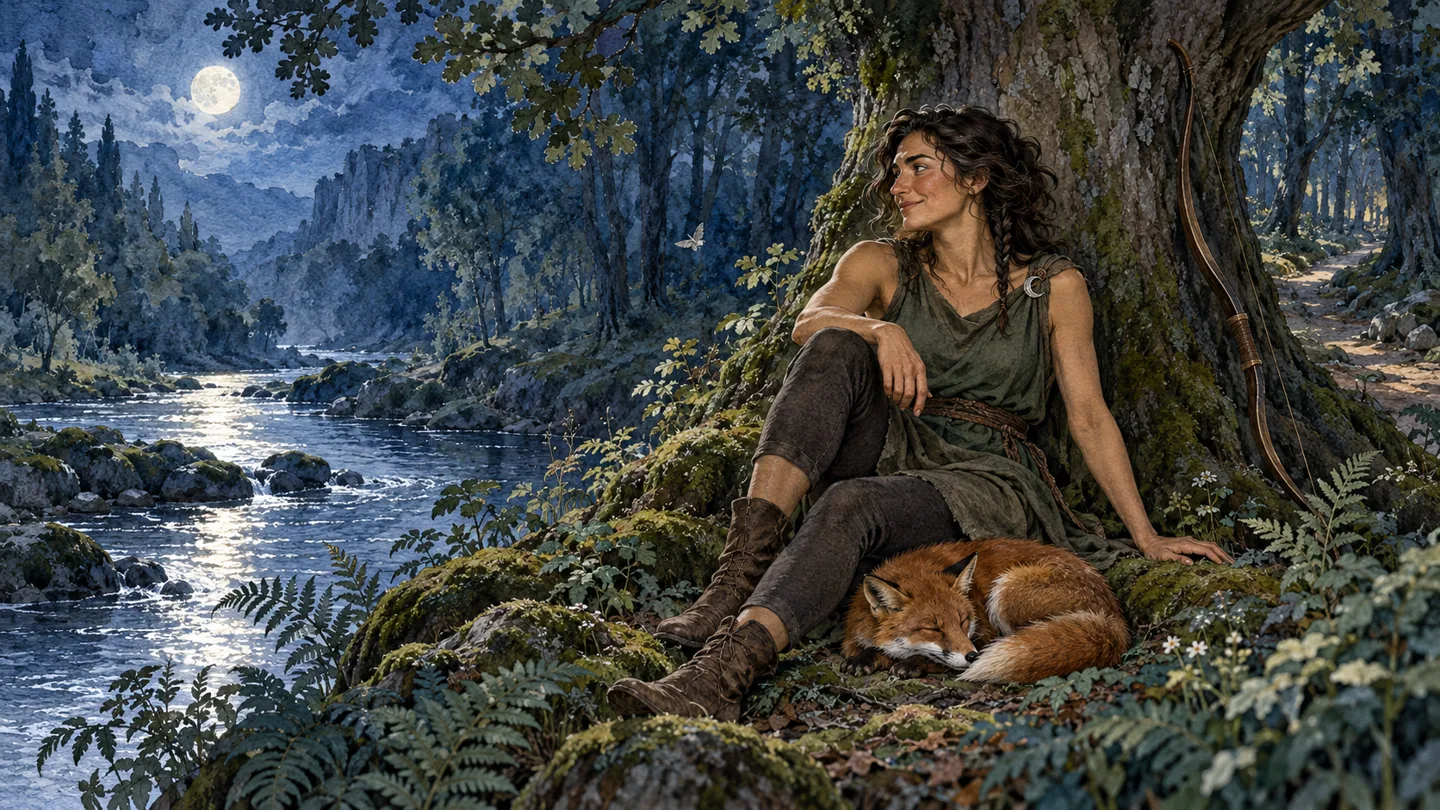
Brief Shapes film artwork: an artistic interpretation, not an archaeological reconstruction.
Sources & further reading
The ancient sources and our modern musical interpretation are distinguished below. This is an introduction to the cited traditions, not an exhaustive catalogue of every ancient reference.
- Callimachus · Hymn 3 to Artemis1–40 · translated by A. W. Mair. Read the source ›
Artemis’s requests, mountains and assistance in childbirth. - Homeric Hymns · Hymn 27 to Artemis1–22 · translated by H. G. Evelyn-White. Read the source ›
Hunting followed by dance at Delphi; a contrasting ancient portrait.
Beyond our artwork
The Metropolitan Museum of Art’s Hellenistic bronze statuette offers an ancient visual representation of Artemis. It is separate from our watercolor invention of a quiet evening in the forest. The image stays on the external institution’s site; no reproduction rights are implied.
External museum record; its image remains on the institution’s website. No reproduction rights are implied.