 Brief Shapes
Follow the Thread gives the microphone to the person who notices the missing half of the heroic plan. Our Ariadne is amused by confidence, impatient with impracticality, and less certain about her own next step than her brisk advice first suggests. The story follows her from solving somebody else’s problem to choosing a departure of her own. Its scale is a palace, a maze and a waiting sea. Its decisive object can fit in one hand.
An agreement, an inquiry, a thread
In Apollodorus’s Epitome, Ariadne falls in love with Theseus and offers help if he will take her to Athens and marry her. After he agrees, she asks Daedalus how the labyrinth can be escaped. Theseus fastens the thread at the entrance, kills the Minotaur, follows it back and sails away with Ariadne and the rescued Athenians. Her assistance is indispensable, and the account explicitly includes the consultation with Daedalus.
This is the foundation of our film, not a claim that Ariadne independently designed the labyrinth or accompanies Theseus through every corridor. Knowing whom to ask, understanding the answer and putting it to use are forms of intelligence worth keeping visible. The film’s practical heroine does not need a falsely expanded ancient résumé to matter.
Sources: Apollodorus.
Beyond the film’s horizon
Plutarch openly records incompatible traditions about what happens to Ariadne afterwards. Some connect her abandonment with death; others bring her into the world of Dionysus. He also preserves a Cypriot account of separation during a storm and death in childbirth, and a Naxian tradition distinguishing two Ariadnes. These should not be assembled into one continuous biography.
Our ending comes earlier. The boat leaves Crete; the later Naxos stories are outside the song. A moment of possibility is not a declaration that every future sorrow has been cancelled. Leaving that horizon open lets the film remain a focused encounter rather than a compressed account of every tradition.
Sources: Plutarch.
The route out is only half the journey
The original lyrics contrast Theseus’s impressive entrance with Ariadne’s very ordinary logistical question. She gives instructions: anchor the thread, unwind it, keep it close and resist the tempting shortcut. The humour comes from treating a legendary enterprise as something that still requires competent preparation. A magnificent speech cannot substitute for remembering the way back.
The palace becomes another kind of enclosure. Our Ariadne describes beautiful rooms and a life bounded by prohibitions; these specific words and circumstances are the film’s dramatic invention. She can explain the maze to someone else while remaining unsure how to leave her own familiar world. That tension changes the repeated instruction from a navigation lesson into an encouragement she also needs.
The waiting matters. She listens for the return, counts the rescued people and prepares to leave before the guards respond. We keep the dangerous encounter offstage rather than turn her song into a second-hand combat report. The emotional action belongs to someone who cannot see around the next bend but has nevertheless made a plan.
When the departure arrives, the thread is no longer only an escape device. The final joke about mending a sail brings it back to useful work. The girl who knows the route is coming too. That turn gives her agency without pretending that the source’s love and marriage bargain never existed: our adaptation deliberately places practical courage and self-directed movement in the foreground.
A line against the maze
The film’s promotional image uses a black-figure-inspired silhouette, terracotta ground, gold contours and a vivid red thread. It borrows a visual vocabulary associated with painted pottery rather than presenting an archaeological reconstruction. The contrast makes an idea legible: a fragile, continuous line can answer an architecture designed to confuse.
Ariadne is not visually swallowed by the hero’s equipment. The thread and the woman holding it occupy the composition together. A simple material becomes the centre of attention because the story is about attention itself—what somebody remembered to consider while everyone else admired the sword.
Before anyone knows what comes next
The film holds one interval between confinement and an uncertain future. It does not need to promise a perfect destination. For this moment, Ariadne’s knowledge has saved others, her fear has not prevented action, and the sea has become reachable. That is enough to celebrate without mistaking a departure for a guarantee.
Ariadne: Follow the Thread
One brief shape.
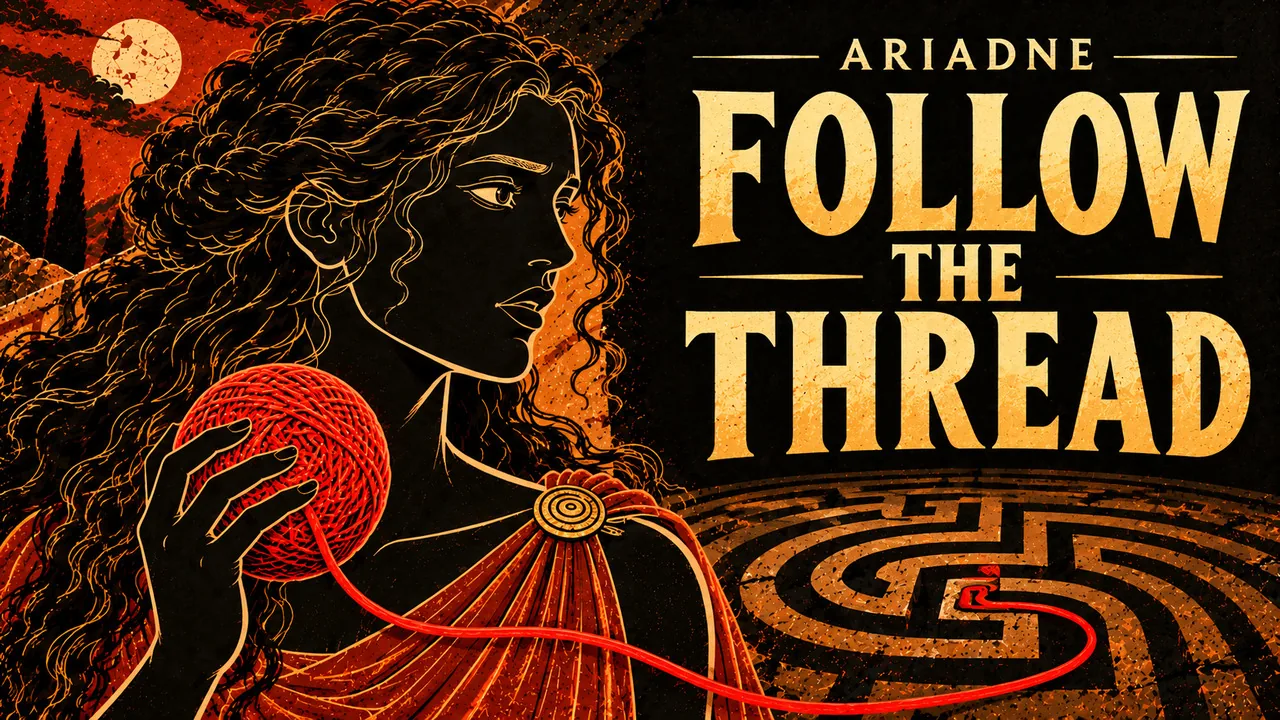
Brief Shapes film artwork: an artistic interpretation, not an archaeological reconstruction.
Sources & further reading
An introduction to the cited ancient traditions, distinguished from the original lyrics, comic situations and visual choices of our film. Not an exhaustive record of every ancient reference.
- Apollodorus · EpitomeI.8–9 · translated by J. G. Frazer. Read the source ›
Ariadne’s agreement, consultation with Daedalus, thread and departure. - Plutarch · Life of Theseus19–20 · translated by Bernadotte Perrin. Read the source ›
Contradictory traditions about Ariadne; especially chapter 20.
Beyond our artwork
The Metropolitan Museum of Art, object 90.12a, b, ca. 130–150 CE. Reliefs move from the thread to the Minotaur and sleeping Ariadne on Naxos, beyond our film’s endpoint. External museum link; no image copied.
Theseus and Ariadne on a Roman sarcophagus ›
External museum record; its image remains on the institution’s website. No reproduction rights are implied.