 Brief Shapes
Our Arachne does not bring a weapon to her confrontation with Athena. She brings work. The danger lies in what the work makes visible. Look Closely stages a contest in which technical excellence is not enough to protect the artist: the more accomplished the image, the harder it becomes for power to dismiss its accusation. Beauty does not soften the argument. It gives the argument somewhere to live.
A contest without a safe victory
Ovid’s Metamorphoses VI.1–145 supplies the surviving extended narrative behind our film. Arachne is a celebrated Lydian weaver who challenges Minerva, the Roman counterpart of Athena. The goddess first visits disguised as an old woman, urging deference. Arachne refuses. In the contest, Minerva represents divine authority and the punishment of challengers; Arachne depicts gods pursuing women through deceptive transformations. Her weaving is faultless. Minerva tears it and strikes her. Arachne attempts to hang herself; the goddess transforms her into a spider, leaving her to weave.
The episode does not end with an impartial judge awarding a prize. Ovid places extraordinary skill beside violent divine displeasure. Our use of the name Athena is a Greek naming choice within an adaptation of this Roman poem, not evidence of a separate recovered Greek script.
Sources: Ovid.
Not simply a lesson against boasting
The older English verse translation hosted by the Internet Classics Archive offers another way into the same episode. It is a translation of Ovid, not an independent ancient variant. Comparing translations can change how a reader hears pride, sympathy and anger, without creating a second plot.
We do not flatten the encounter into a schoolroom warning that talented people must never challenge authority. Nor do we present our sympathetic Arachne as the only possible reading of the poem. The adaptation makes a deliberate choice about where the emotional weight falls: on an artist whose work shows something that a powerful spectator wants removed.
Sources: Ovid.
The accusation is in the thread
The song begins with a polished account of divine greatness. Arachne answers that self-portrait by bringing the viewer nearer. The refrain is an instruction to inspect: the uncomfortable story is already present in the details. Her references to a swan and a bull turn familiar mythic disguises into questions about the people on the receiving end of divine desire.
Athena is not merely incapable of recognizing good work. The lyric grants her the ability to see Arachne’s technique, and makes that recognition part of her anger. Admiration cannot be separated neatly from offence. A lesser tapestry might have been easier to ignore. This one is troublesome because it succeeds.
The exchange about what art should show is original dialogue. Arachne refuses the suggestion that she could have chosen harmless gardens instead. Her palette becomes an ethical decision: the same picture must make room for pleasure and injury. The red thread is not an ornament added after the argument. It is how the argument enters the image.
We omit the hanging episode and make the transformation non-graphic. That is an adaptation decision, not an amendment to Ovid. The invented ending places a web between a statue’s fingers. Arachne’s body and scale have changed, but the impulse to make has not been extinguished. Her final return to colour keeps her artistic intelligence alive without pretending that nothing was lost.
Gold, blue, and a difficult gaze
The still-image film gives the tapestry a physical presence between the two women. In the selected artwork, its saturated blue and gold occupy the centre while Athena leans in and Arachne waits on the other side. The composition makes looking an action with consequences. A face, a hand and the distance between them can carry a confrontation without rapid character animation.
This is dramatic rather than a comic victory lap. Arachne’s wit remains, but the setting does not excuse what happens to her. The small web at the end belongs to Brief Shapes’ interest in fragile things that persist: not an empire defeated, but a thread that someone is still placing.
Look Closely
One brief shape.
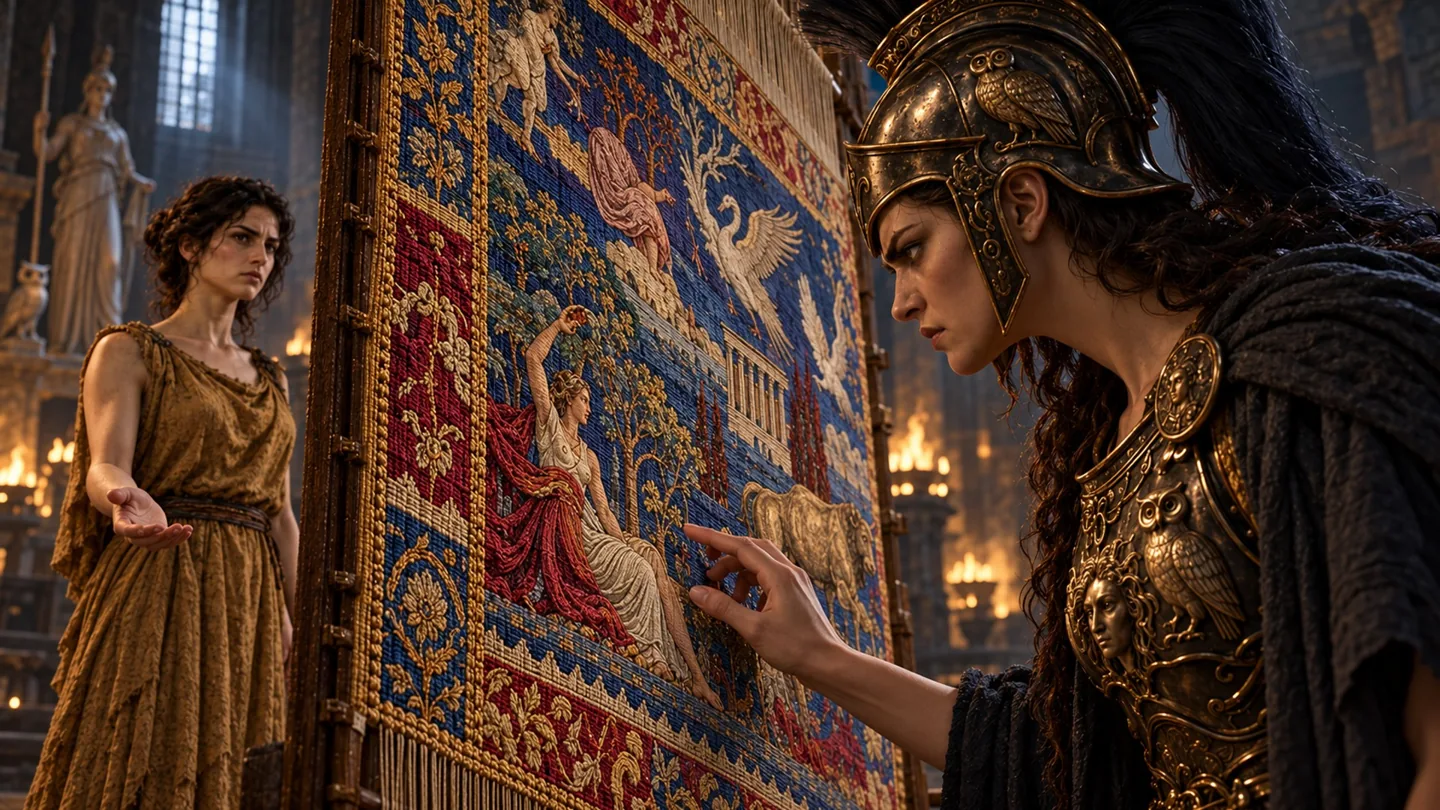
Brief Shapes film artwork: an artistic interpretation, not an archaeological reconstruction.
Sources & further reading
The ancient sources and our modern musical interpretation are distinguished below. This is an introduction to the cited traditions, not an exhaustive catalogue of every ancient reference.
- Ovid · MetamorphosesVI.1–145 · translated by Brookes More. Read the source ›
The weaving contest, destroyed work and transformation. - Ovid · MetamorphosesBook VI, opening episode · translated by Sir Samuel Garth, John Dryden, et al.. Read the source ›
An alternative English translation of the same ancient account, not a separate mythic variant.
Beyond our artwork
Velázquez’s painting in the Museo del Prado is a later artistic response to Arachne, not an ancient depiction. Compare another artist’s way of placing weaving and the myth in the same image. The image stays on the external institution’s site; no reproduction rights are implied.
The Spinners, or the Fable of Arachne ›
External museum record; its image remains on the institution’s website. No reproduction rights are implied.