 Brief Shapes
Apollo enters with impeccable confidence, a guest and an entirely reasonable monument to himself. The joke is not that he has no talent. He has so much talent that he can use it to occupy every available opening. Our rap musical asks what happens when a god who knows how to command attention is finally asked to share it.
Music, prophecy and a dazzling entrance
The Homeric Hymn to Apollo connects him with the lyre, the bow and the declaration of Zeus’s will. Its Delian section celebrates his birth to Leto on Delos and the festival gathering around him. In the Pythian section he plays among the gods; the Muses sing, other deities dance, and his parents delight in the spectacle. The poem also tells of his search for an oracular sanctuary. These are useful roots for our musician’s instruments, prophetic confidence and appetite for an entrance.
The hymn is not the source of a rap contest or a lesson in listening. Those belong to our film. We borrow an identity, not a preserved incident.
Sources: Homeric Hymns.
The lyre is not the whole god
At the beginning of the Iliad, Apollo responds to the dishonouring of his priest Chryses by sending plague among the Greeks. At the end of the same book, his lyre accompanies the gods’ feast alongside the Muses. The juxtaposition matters: a god of beautiful music is not necessarily gentle, harmless or available on human terms.
These scenes are not contradictory biographies that must be reconciled into a modern personality profile. They show different registers of divine power. Our affectionate satire selects one register and changes the stakes. An interrupted singer replaces an army in danger; a failure of attention replaces divine punishment. We are not retelling the Marsyas story, and the guest should not be identified as Marsyas.
Sources: Homer.
From me to we
The lyric builds its comedy through repeated promises of modesty. Each denial of self-importance arrives attached to a new demonstration of it. Apollo has brought a sculpture, predicted an admiring future and found a way to make another person’s childhood remind him of his own. The speed of the rap becomes part of the problem: his verbal skill leaves almost no gap for anyone else.
He does invite a guest. That makes the failure more recognizable than simple exclusion. She is physically offered a place on stage, but every attempt to speak is absorbed into his performance. The song distinguishes being present from being heard. A duet does not exist merely because two bodies appear in the same scene.
The turning point is a direct question about whether he has finished. The guest does not ask him to become smaller, lose his gold or abandon his ability. She asks him to leave space. That is the important generosity of the correction: another voice need not diminish his own. Collaboration can produce something a soloist cannot, however gifted the soloist may be.
The final movement changes the pronoun and the musical relationship. Apollo begins to listen, though his pleased remark about being exceptionally good at it immediately exposes the old reflex. The last joke prevents an implausibly complete conversion. He has learned something, but remains recognizably himself. The guest can answer him without the film turning her into an admirer who exists only to certify his improvement.
A very fast song in very old stone
The imagery sets the rap against weathered classical sculpture: cracked marble, moss, vegetation and traces of cobweb. The selected artwork shows Apollo gesturing before an enlarged likeness of himself while his companion waits nearby. This is an invented sculptural stage, not documentation of a particular archaeological site.
The contrast is deliberate. The music rushes forward while stone carries the appearance of age and stillness. Camera moves and successive images give the animatic its bounce without pretending that the figures are live-action performers. Apollo’s self-monumentalizing impulse becomes literal, and the surface is already weathering.
For Brief Shapes, the valuable moment is not the enormous entrance. It is the small interval in which a confident person stops filling the room and allows someone else to begin. The musical can remain extravagant while making that quiet act its destination.
A Modest Song About Me
One brief shape.
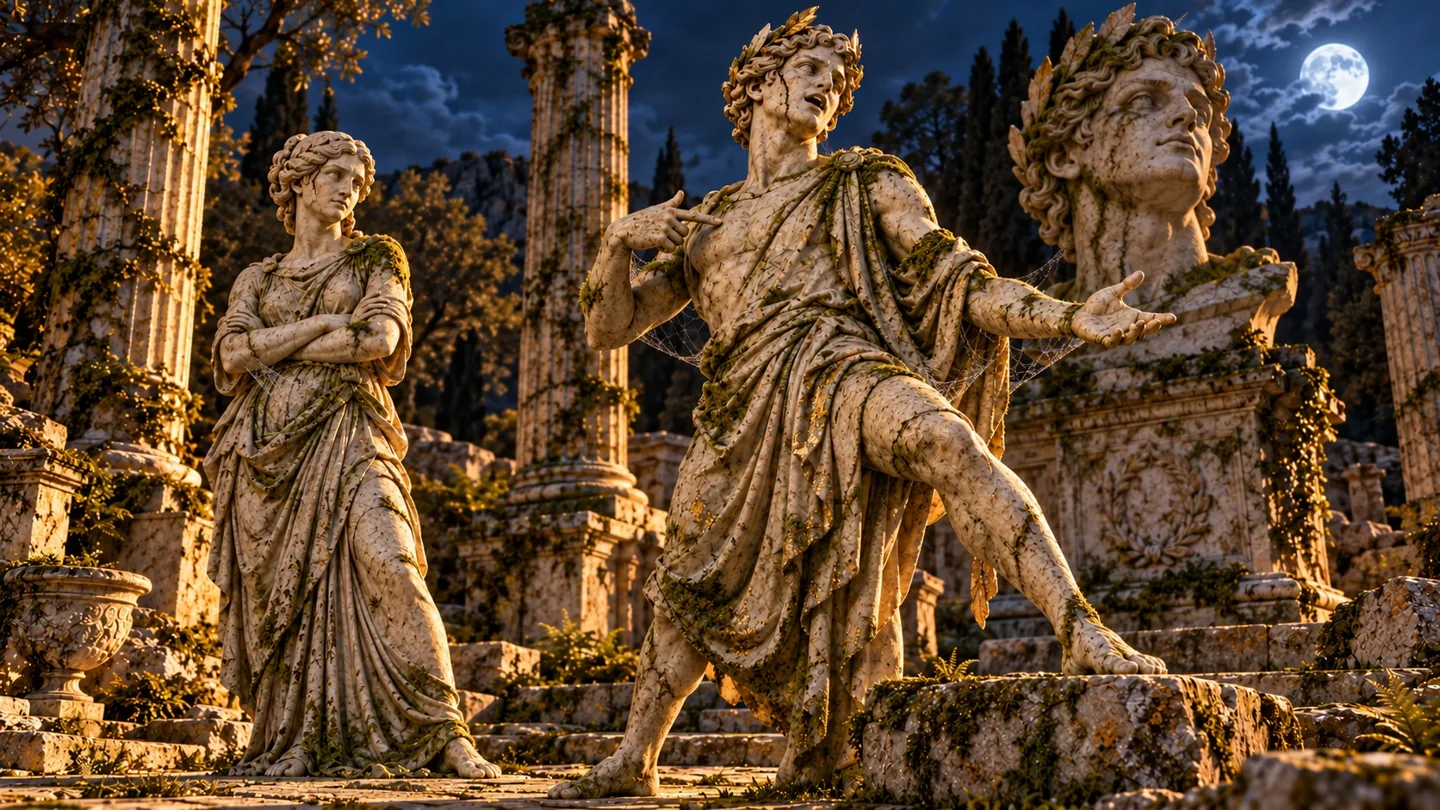
Brief Shapes film artwork: an artistic interpretation, not an archaeological reconstruction.
Sources & further reading
The ancient sources and our modern musical interpretation are distinguished below. This is an introduction to the cited traditions, not an exhaustive catalogue of every ancient reference.
- Homeric Hymns · Hymn 3 to ApolloDelian section 1–178, especially 127–164; Pythian section 179–206 · translated by H. G. Evelyn-White. Read the source ›
Birth, music, prophecy and the divine performance; background rather than the plot of our film. - Homer · IliadBook I.8–52 and 601–604 · translated by A. T. Murray. Read the source ›
Apollo as plague-bringer and as musician at the gods’ feast.
Beyond our artwork
The Metropolitan Museum of Art’s Hellenistic limestone statue from Cyprus shows Apollo carrying a kithara, now partly lost. An ancient image of the musical god, not a model for the events of our invented rap. The image stays on the external institution’s site; no reproduction rights are implied.
External museum record; its image remains on the institution’s website. No reproduction rights are implied.